
 Türkçe
 English
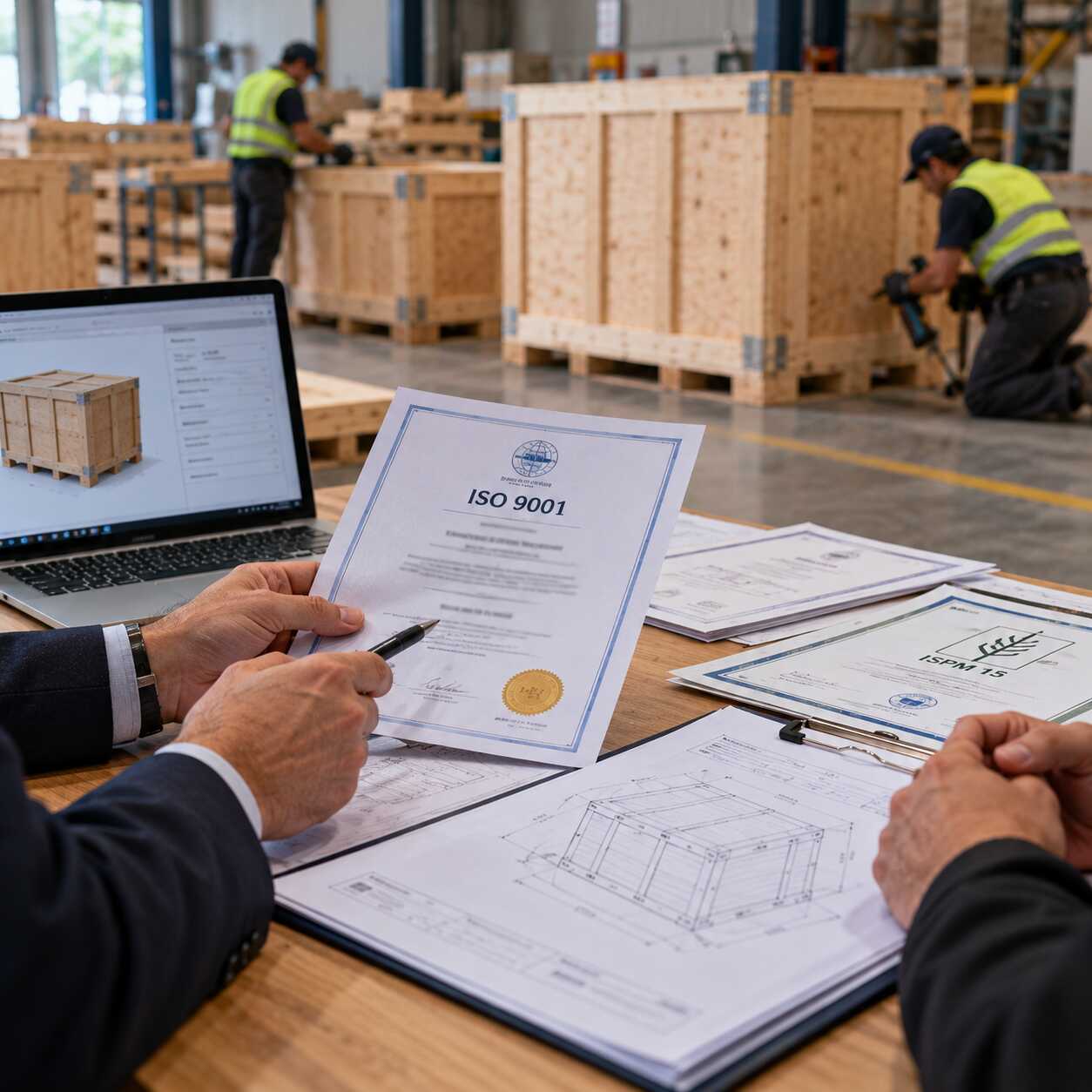
Certification in Procurement
Reviewing quality certifications is an important step when selecting a wooden crate and packaging supplier. For machinery, automotive, and industrial equipment manufacturers in particular, packaging is more than a material used to prepare products for shipment; it is also critical to transport safety, production continuity, and export requirements. Checking a supplier's certifications and quality processes helps support procurement decisions with verifiable information.
The mere presence of a certificate should not be considered sufficient. Also review its scope, validity, issuing organization, and whether it covers the relevant production activities.
The Role of Quality Certifications in Corporate Procurement
Quality management system certificates may show that a business has been assessed against specified management requirements. They do not, by themselves, prove that every wooden crate produced has a particular load capacity or is suitable for every shipping condition.
Procurement teams should assess certifications alongside production capacity, technical competence, quality inspection records, and delivery performance. This makes it easier to compare different wood packaging suppliers against shared criteria.
Checking Certificate Scope and Validity
It is important to check not only whether a quality certificate is current, but also which activities it covers. For example, a general management system certificate does not mean that every technical requirement for custom wooden crate production has been met.
Check the legal business name, operating address, scope description, and validity information on the certificate. Where necessary, conduct additional checks through the issuing organization or an applicable verification system.
Criteria for Assessing a Wooden Crate Supplier
- Certificate validity: Verify that certifications are current.
- Scope of activities: Check that certificates cover the relevant production and service processes.
- Technical capability: Assess the supplier's ability to design crates suited to product weight and shipping conditions.
- Production control: Review material acceptance, assembly, and final inspection practices.
- Traceability: Check how order, production, and quality records are managed.
How Certification Supports Quotation Comparisons
Evaluating quotations solely by unit cost can cause quality and operational requirements to be overlooked in corporate procurement. A supplier assessment supported by documents provides insight into the criteria used to manage production processes.
For export crates, verify ISPM 15 treatment and marking authorizations separately from general quality management certifications. Clearly defining document, technical drawing, inspection record, and delivery expectations in the procurement specification creates a comparable and traceable decision process for wooden crate sourcing.
ISO Quality Approach
When selecting a wooden crate and packaging supplier, the ISO quality approach gives corporate procurement teams a systematic framework for assessing how production processes are managed. For custom wooden crates, export crates, and industrial packaging in particular, it is important to interpret order requirements correctly, apply production controls, and manage nonconformities. ISO 9001 specifies requirements for managing these processes consistently.
An ISO 9001 certificate is not a durability certificate for a particular product model. It indicates that the quality management system within the certification scope conforms to the relevant standard requirements. A wooden crate's load capacity and structural suitability must be verified separately using technical data.
Scope of the ISO 9001 Quality Management System
ISO 9001 covers areas such as meeting customer requirements, managing processes, assessing risks, and continual improvement. In wood packaging production, this approach can be applied to quotation review, material acceptance, production planning, assembly inspection, and customer feedback management.
The ISO 9001:2026 edition, published by ISO on September 16, 2026, strengthens its focus on quality culture and leadership. Check the transition status of certificates issued to the previous edition according to the process established by the certification body.
How to Assess the Validity of an ISO Certificate
ISO standards are published by the International Organization for Standardization, but ISO does not issue certificates directly. Independent organizations perform certification activities. Accredited certification may provide additional assurance regarding a certification body's competence.
Procurement teams should review the company's legal name, operating address, scope, standard edition, and certificate validity. A certificate that covers only general trading activities does not show that wooden crate production at a manufacturing facility is within the certification scope.
ISO Checks for a Wood Packaging Supplier
- Certification scope: Check the relevant production activities and facilities.
- Certification body: Verify the organization that issued the certificate.
- Edition and validity: Review the applicable ISO 9001 edition and transition status.
- Production records: Assess material, assembly, and final inspection processes.
- Corrective actions: Review how nonconformities are recorded and resolved.
How the ISO Approach Supports Supplier Selection
For corporate procurement, an ISO 9001 certificate should not be the sole criterion for supplier evaluation. Also assess conformity to technical drawings, product traceability, delivery performance, and production capacity.
Verify required ISPM 15 heat-treatment and IPPC-marking authorizations independently of the ISO 9001 certificate. Assessing the certificate scope alongside actual production practices supports more reliable purchasing decisions for wooden crate supply.
ISPM 15 and Heat-Treatment Competence
When selecting a wooden crate and packaging supplier, ISPM 15 compliance is a key criterion for assessing the plant health requirements of international shipments. Solid wood crates, pallets, and dunnage used to export machinery, automotive parts, and industrial equipment may fall within the standard's scope. Businesses purchasing heat-treated export crates should not rely solely on the supplier's claims; they should verify treatment competence, authorization status, and traceability records.
ISPM 15 is not a general quality management certification. It sets treatment and marking requirements intended to reduce the risk of harmful organisms being transported in wood packaging. Holding an ISO 9001 certificate does not automatically authorize a business to apply the IPPC mark.
Technical Requirements for Heat-Treatment Competence
Under the conventional heat-treatment method identified by the HT code in ISPM 15, the entire cross-section of the wood, including the core, must reach at least 56°C for a continuous period of 30 minutes. Treatment compliance should not be assessed solely by checking the ambient temperature inside the kiln. The treatment schedule, temperature-monitoring system, and records must meet the relevant technical requirements.
Assess heat-treatment competence alongside suitable equipment, measurement controls, qualified personnel, and documented treatment procedures. Missing temperature records or unverifiable treatment information should be treated as a nonconformity in supplier evaluation.
Verifying Authorization and the IPPC Mark
In Turkey, heat treatment and ISPM 15 marking activities are carried out under an authorization system administered by the Ministry of Agriculture and Forestry. Exporters should check the current authorization status of the relevant treatment provider.
The IPPC mark must include the symbol, country code, authorized facility code, and treatment code. Unauthorized marking or packaging with unverifiable treatment history creates a shipment-compliance risk.
ISPM 15 Checklist for Supplier Selection
- Authorization status: Verify authorization for treatment and marking.
- Treatment conditions: Check that the method used meets technical requirements.
- IPPC mark: Inspect marking codes and legibility.
- Traceability: Assess treatment reports and relevant production records.
- Regulatory monitoring: Verify current obligations and transition dates.
Regulatory Compliance in Procurement
Take Turkey's regulation dated July 26, 2024, and its amendment dated December 30, 2025, into account when evaluating suppliers. Separately check effective dates for traceability marking and QR-code requirements.
Corporate procurement teams should clearly define authorization, treatment records, and delivery inspections in the technical specification. Assessing production quality together with ISPM 15 competence supports a compliant and traceable procurement process for export crates.
Production Standardization
Standardization in wooden crate and packaging production aims to fulfill orders with the same technical requirements using defined methods and consistent quality criteria. Dimensional accuracy, material selection, and joint quality affect shipping safety for crates used to export machinery, automotive products, and industrial equipment. For corporate procurement teams, production standardization demonstrates not only a wooden crate supplier's capacity, but also its ability to control its processes.
A standardized production approach does not mean supplying every customer with crates of identical dimensions and construction. Product-specific requirements can still be met for custom wooden crates by standardizing technical drawings, work instructions, and inspection criteria.
Managing Technical Drawings and Production Instructions
Before production begins, define crate dimensions, load-bearing base construction, forklift entries, and connection points on approved technical drawings. Ensuring production staff use the current drawing revision reduces the risk of manufacturing to outdated dimensions.
Written instructions for cutting, assembly, and final inspection make it easier to manage variation in how work is performed. Evaluate customer-requested design changes before releasing them to production.
Consistency in Material and Assembly Processes
Compare lumber, plywood, fasteners, and support materials used in wood packaging with the specified technical requirements. Incoming material inspections help prevent unsuitable components from entering production.
During assembly, check nail and screw placement, fastener spacing, and the position of load-bearing members. Use suitable measuring equipment and defined acceptance tolerances for critical dimensions.
Standardization Criteria for Wooden Crate Production
- Technical documents: Use current drawings and production instructions.
- Material acceptance: Assess components against the order specification.
- Assembly layout: Verify fasteners and support points.
- Dimensional inspection: Compare critical dimensions against defined tolerances.
- Nonconformity management: Record defects and track corrective actions.
Relationship Between Quality Certifications and Production Performance
Quality management system certificates such as ISO 9001 help assess production processes against specified management requirements. A certificate does not automatically prove the technical conformity of every wooden crate. Review production records and completed-product inspections separately.
For corporate supplier assessments, dimensional nonconformities, rework rates, and delivery performance can be used as traceable indicators. Standardized production processes make it easier to verify that wooden export crates meet order requirements and to identify the source of quality issues.
Traceability and Trust
Traceability in wooden crate and packaging supply is the record-keeping system that links materials, production processes, and quality inspections to a specific order. It is important to verify the technical requirements used to produce packaging for exports of machinery, automotive products, and industrial equipment. For corporate procurement teams, traceability focuses supplier-reliability assessments not only on the presence of documents, but also on actual production processes.
Holding a quality management system certificate does not automatically make all production information traceable. Separately check that records are accurate, current, and linked to the relevant wooden crate order.
How to Establish Traceability in Wooden Crate Production
For custom wooden crate production, key records may include the order number, technical drawing revision, material information, and production date. Managing these details in a shared file makes it easier to compare delivered packaging with approved requirements.
Product identification is especially important for businesses producing crates of different dimensions during the same production period. An order code or production label on the crate can help users access the relevant quality inspection records.
Relationship Between Quality Certifications and Process Records
Quality management system certificates such as ISO 9001 provide a framework for controlled process management. The transport strength, dimensional conformity, and assembly quality of wood packaging must still be assessed for each product.
For heat-treated export crates within the scope of ISPM 15, separately verify the authorized treatment provider, IPPC mark, and applicable treatment records. A general quality management system certificate does not replace phytosanitary authorization.
Supplier Traceability Checklist
- Order record: Link each produced crate to the relevant customer request.
- Technical document: Verify that the drawing used is the current approved revision.
- Material information: Ensure access to required supplier and batch records.
- Production inspection: Record dimensional and assembly inspections.
- ISPM 15 compliance: Check applicable treatment and marking information.
- Nonconformity management: Link corrective actions to the relevant order.
How Traceability Affects Supplier Reliability
Traceable records make it easier to investigate dimensional, connection, or packaging nonconformities identified after delivery. The supplier can show more clearly at which production stage a change was made and which inspections were performed.
For corporate procurement, assess record accessibility, certificate validity, and production consistency together. Regular traceability practices support the use of verifiable data in quality discussions with a wooden crate supplier and clarify responsibilities in long-term supply relationships.
Corporate Supplier Expectations
Selecting a wooden crate supplier for corporate procurement involves more than price and delivery time. Machinery manufacturers, automotive suppliers, and industrial equipment exporters expect packaging suppliers to demonstrate technical competence, consistent production, and documented quality inspections. For custom wooden crate orders in particular, the supplier must interpret the customer's specification correctly and support production outcomes with verifiable information.
Corporate supplier expectations vary with the order. One-off project crates and packaging for regular export shipments may have different capacity, planning, and traceability requirements. Define evaluation criteria clearly during procurement.
Technical Competence and Production Capacity
A wooden crate manufacturer is expected to develop a construction suited to the product's weight, external dimensions, and transport method. Plan forklift entries, load-bearing skids, fasteners, and internal bracing according to the product's conditions of use.
When assessing production capacity, review not only the number of crates produced per day, but also the supplier's ability to manage orders in different dimensions and meet approved lead times. Capacity claims should be supported by viable production plans.
Quality Certifications and Regulatory Compliance
Corporate customers may request a supplier's quality management system certificates and production inspection records. Certifications such as ISO 9001 support supplier assessment but do not, by themselves, guarantee product strength.
For international shipments, separately verify authorized heat treatment and IPPC marking requirements for wood packaging within the scope of ISPM 15. If the supplier and treatment provider are different, clearly define their responsibilities.
Criteria for Assessing a Corporate Wooden Crate Supplier
- Technical competence: Assess custom-sized and heavy-load constructions.
- Quality management: Review certification scope and production inspection records.
- Regulatory compliance: Verify required treatment and marking authorizations.
- Lead-time performance: Check production planning and delivery consistency.
- Traceability: Ensure access to order and technical drawing records.
- Communication: Require regular updates on technical changes and nonconformities.
Managing Long-Term Supplier Relationships
In corporate operations, supplier performance can be tracked through delivery accuracy, product nonconformities, and completion of corrective actions. Regular reviews help identify recurring production defects and manage procurement risks.
Keeping technical specifications current and implementing changes with written approval strengthens coordination between the customer and packaging manufacturer. Assessing certificate validity, production capacity, and operational performance together helps ensure that corporate purchasing decisions are based on measurable criteria.
Quotation Evaluation Criteria
Quotation evaluation criteria are an important control when selecting a wooden crate and packaging supplier, helping ensure that procurement decisions are not based on price alone. For packaging used to export machinery, automotive products, and industrial equipment, assess technical specifications, quality certifications, production capacity, and delivery conditions together. For custom wooden crate orders in particular, basing quotations from different suppliers on the same technical specification makes meaningful comparison easier.
The lowest unit price does not always represent the best total procurement cost. Differences in crate construction, material selection, shipment preparation, and potential rework can all affect the purchasing decision.
Conformity with the Technical Specification
The first step in reviewing a quotation is to assess whether the proposed wooden crate meets the product's dimensions, weight, and transport requirements. Compare the load-bearing base, forklift entries, fasteners, and internal bracing solutions with the technical drawings.
When quotations use different materials, matching external crate dimensions alone is not sufficient. Record construction details and any technical exceptions separately.
Quality Certifications and Production Competence
Verify the scope and validity of the supplier's quality management system certificates. An ISO 9001 certificate may help assess process management, but it does not, by itself, prove the load capacity of a specific wooden crate.
For heat-treated export crate requests, separately check treatment and IPPC marking authorizations under ISPM 15. Link the identity of the treatment provider and applicable traceability records to the quotation scope.
Wooden Crate Quotation Evaluation Checklist
- Technical suitability: Are dimensions, support structure, and product restraint requirements met?
- Material properties: Do the wood and fasteners conform to the specification?
- Quality certifications: Have certificate scope and validity been verified?
- ISPM 15 requirements: Are required treatment and marking included in the quotation?
- Lead time: Does the production and delivery plan meet the shipment schedule?
- Total cost: Have transport, additional processing, and potential revision costs been assessed?
Comparable Quotations and Supplier Approval
Corporate procurement teams can evaluate technical suitability, quality, delivery, and price using weights defined in advance. Selecting a quotation solely because of its low price, when it does not meet critical technical requirements, may create operational risk.
When approving a quotation, record current certificate copies, the technical specification, delivery scope, and any exceptions. Defining change management in writing between the customer and wooden crate manufacturer helps reduce disputes after the order is placed. Quotation evaluation based on verifiable criteria helps manage quality and cost expectations together in corporate packaging procurement.