
 Türkçe
 English
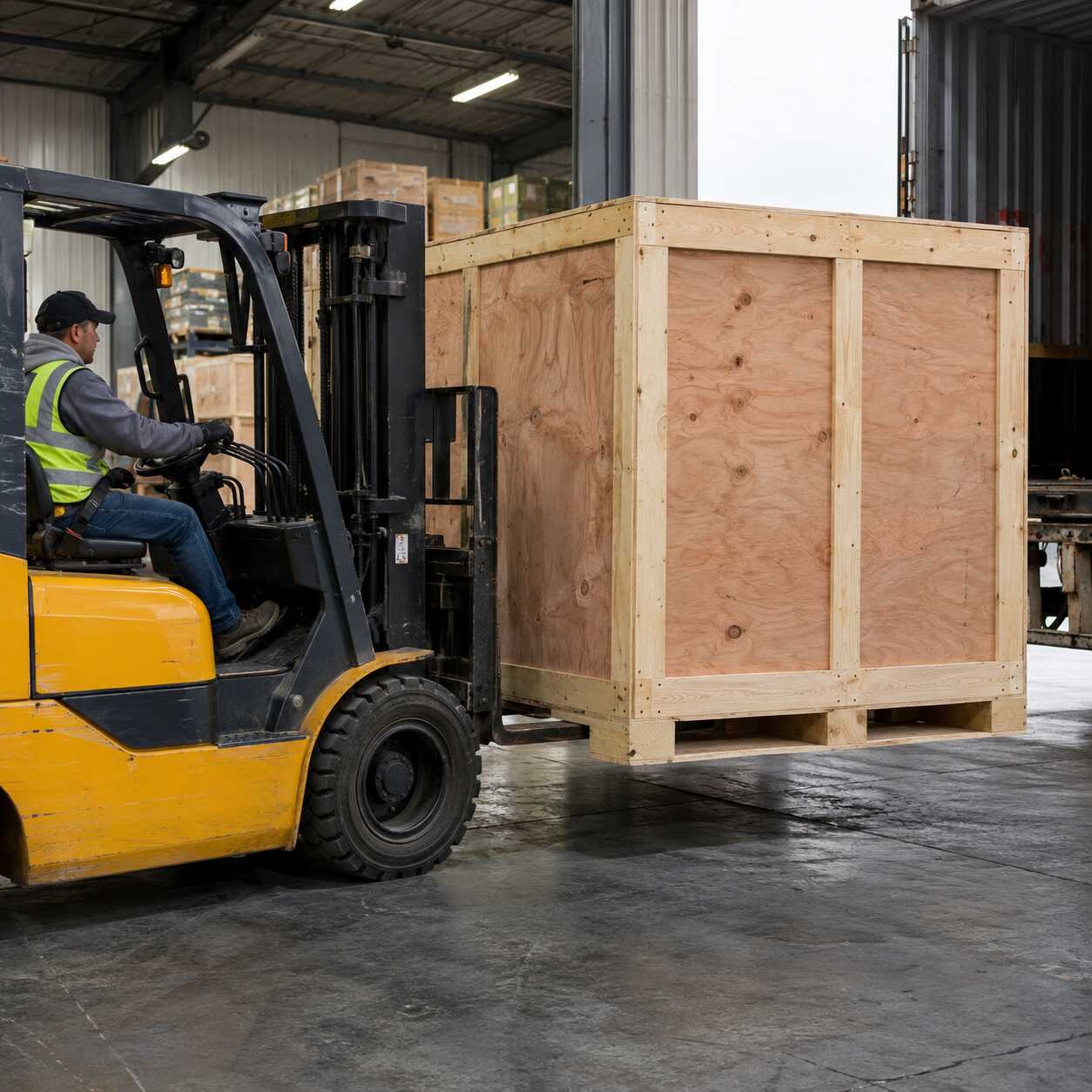
Purpose of Forklift Entry
Forklift entry is an important design feature of a wooden export crate, allowing packaged products to be lifted and moved safely in warehouses, manufacturing facilities, and shipping areas. For crates built for heavy machinery, industrial equipment, and oversized components, lifting must take place at suitable points. Properly positioned forklift entries help maintain load balance and manage the forces transferred to the crate structure during handling.
Designing a wooden crate for forklift access involves more than leaving openings in the base for the forks. Entry dimensions, the position of the load-bearing skids, the product's center of gravity, and the forklift's specifications must all be considered together. Poorly designed entries can destabilize the package during lifting or deform its supporting members.
Forklift Entry During Lifting and Handling
Forklift forks carry the load when inserted into designated lifting areas in the lower structure of the wooden export crate. These areas transfer the packaged product's weight evenly to the forks. For heavy loads in particular, the forks must provide sufficient support and prevent uncontrolled movement during lifting.
Skids and load-bearing supports in the crate base are structural elements that enable forklift access. Directing fork contact toward non-load-bearing panels or joints can increase the risk of damaging the wood packaging.
Forklift Entry Directions for Export Crates
Depending on operational requirements, wooden crates can provide forklift access from specific directions. When considering two-way or four-way entry, the load capacity of the crate base must be maintained. A design that permits fork entry from every side should not be assumed to suit every product.
Warehouse aisles, loading vehicles, and container door openings can affect the direction from which a forklift can approach the crate. Defining entry directions in advance makes it easier to prepare packaging for site conditions.
Key Criteria for Forklift-Accessible Wooden Crates
- Fork clearance: Specify entry dimensions according to the forklift's fork and equipment specifications.
- Load balance: Assess the product's center of gravity and the forces generated during lifting.
- Load-bearing base: Design skids, cross members, and connections for the expected loads.
- Entry direction: Provide access suited to movement in the warehouse and shipping area.
- Equipment suitability: Verify the forklift's capacity and load-center limits.
Forklift Access in Custom Wooden Crate Production
Planning forklift entries alongside the product's technical drawings supports safe lifting and handling of custom wooden crates. For machines with non-standard dimensions in particular, the height of the crate base and the position of its supporting members also affect the package's overall dimensions.
For corporate export operations, the manufacturer, warehouse, and logistics teams should share the specifications of the forklift to be used in advance. Preparing a wooden export crate for forklift access helps establish controlled handling conditions during loading and unloading.
Crate Base Construction
The base construction of a wooden export crate is its primary structural section: it supports the product's weight and provides safe contact with handling equipment. The strength of the crate base directly affects overall packaging performance, particularly when shipping heavy machinery, industrial equipment, and oversized components. For forklift-accessible wooden crates, load-bearing skids, cross members, and connection points must be planned to suit the product. The base is not merely a platform that raises the package off the floor; it is a system that withstands forces during lifting and handling.
When designing the crate base, determine the product's net weight, center of gravity, and approved support points. Concentrated loads can bend wooden members or place stress on connections. The position of load-bearing components should be technically assessed for the expected loading conditions.
Purpose of Load-Bearing Skids and Cross Members
Skids in a wooden crate's base help transfer the product's weight to the floor and lifting equipment. Cross members can distribute the load among supporting elements. Their dimensions, spacing, and connection methods, however, vary by application.
For custom wooden crates, the product's feet and the supports in the base must be positioned to work together. Inadequate support spacing, particularly under heavy loads, can deform the crate base or destabilize the product.
How Forklift Openings Affect the Structure
When creating forklift entry openings, maintain the continuity of the lower support system. Openings for the forks affect the positioning of skids and cross members. Insufficient entry height can make it difficult to position the forklift correctly.
When planning two-way or four-way forklift access, identify which members will transfer the lifting forces. For four-way entry in particular, separately verify that the support arrangement provides sufficient strength in each lifting direction.
Technical Criteria for Base Construction
- Product weight: Design the support system for the total load, including packaging, and the expected mechanical forces.
- Timber dimensions: Specify skid and cross-member dimensions based on load transfer and material strength.
- Connection integrity: Assess the suitability of screws, nails, and other fasteners.
- Forklift access: Ensure openings suit the fork dimensions and lifting directions.
- Floor contact: Plan crate support points for the storage and transport surfaces.
How the Crate Base Affects Shipping Performance
A properly designed wooden export crate base helps keep the product stable during warehouse handling and container loading. Dynamic forces generated during forklift lifting should not be assessed solely against the crate's static load capacity.
For corporate export operations, share product drawings, gross weight information, and the lifting method with the packaging manufacturer. A load-bearing base designed for forklift access enables the custom wooden crate to meet safe handling and shipping requirements.
Safe Loading and Unloading
Safe loading and unloading of wooden export crates is essential for protecting products in transit and keeping handling operations under control. Base design is especially important when forklifts are used to move heavy machinery, industrial equipment, and oversized components. Forklift-accessible wooden crates allow handling equipment to support the load at suitable points, helping reduce the risk of uncontrolled movement and structural stress.
Loading safety should not be assessed solely by the forklift's rated capacity. Consider the wooden crate's gross weight, center of gravity, position of load-bearing skids, and fork support spacing together. Improper lifting can destabilize the crate and place stress on the product's restraints inside the package.
Maintaining Load Balance During Forklift Lifting
Positioning the forklift forks correctly at the designated entry points beneath a wooden crate is important for balanced lifting. If the forks do not provide adequate support, the crate base may bend or slip, or the load may rotate uncontrollably.
Prepare a product-specific lifting plan for machinery whose center of gravity is offset from its geometric center. Before operation, verify the forklift's load-center limits, capacity, and attachment specifications.
Safe Handling During Container and Vehicle Loading
Moving a wooden export crate through a container doorway requires careful planning because of the restricted maneuvering space. Assess the crate's external dimensions, the forklift's maneuvering requirements, and the container floor's load limits together.
During unloading, equipment capacity and access at the destination also matter. Do not assume that a crate safely handled with a forklift at the manufacturing site can be handled in the same way by equipment with a different capacity.
Safety Checks Before Loading and Unloading
- Gross weight: Compare the combined weight of the product and wooden crate with the forklift's capacity.
- Fork placement: Use the forklift entries and load-bearing support points correctly.
- Load balance: Assess the center of gravity and possible movement during lifting.
- Work area: Check floor conditions, access openings, and maneuvering clearance.
- Personnel safety: Maintain a safe working distance around suspended loads.
Technical Planning for Operational Safety
For custom wooden crates, identifying forklift entry directions and lifting points on the technical drawings helps operations teams handle the package correctly. Where needed, use markings on the package to show the appropriate lifting directions.
For corporate export operations, the packaging manufacturer, warehouse supervisors, and logistics providers should share lifting information. Having trained, authorized personnel perform loading and unloading with suitable equipment helps protect the product and ensures the wooden crate is handled according to its intended use.
Warehouse Operational Efficiency
Properly designed forklift entries in wooden export crates help warehouse operations run efficiently and according to plan. Manufacturers, automotive suppliers, and industrial equipment providers regularly handle packaged products as they are received, positioned, and moved to shipping areas. Forklift-accessible wooden crates can make it easier to lift loads with suitable equipment and reduce the need for additional interventions during handling.
Warehouse efficiency should not be measured solely by forklift travel time. Accessing the product, preparing for the lift, following the handling route, and setting down the load safely all affect total processing time. The wooden crate's base construction should support each of these steps.
How Forklift Access Affects In-Warehouse Material Flow
Positioning forklift entry openings appropriately makes it easier for operators to approach from the correct direction and insert the forks at designated support points. In narrow warehouse aisles or areas with limited maneuvering space, an unsuitable entry direction may require the crate to be repositioned.
For custom wooden crates, assess two-way or four-way access alongside the warehouse layout. More entry directions do not always mean faster operations; the strength of the load-bearing base and the specifications of the equipment must be maintained.
Design That Reduces Delays in Loading Preparation
Moving wooden export crates into a consistent position for shipment can make it easier to follow the loading sequence. Defining forklift entries in advance can reduce extra steps, such as turning the package to determine the lifting direction or raising it on temporary supports.
Check that crate dimensions suit warehouse doors, vehicle loading areas, and container entrances. Even with suitable forklift access, packaging that does not fit through access openings can delay operations.
Efficiency Criteria for Warehouse Operations
- Forklift entry direction: Plan crate access around warehouse aisles and handling routes.
- Fork compatibility: Compare entry openings and support surfaces with the forklift specifications.
- Storage layout: Position crates while preserving safe lifting and maneuvering space.
- Loading sequence: Coordinate the movement of packages to the shipping area with the planned vehicle loading order.
- Operational tracking: Review handling times, repositioning needs, and waiting periods.
Crate Standardization in Corporate Warehouse Management
Using compatible forklift entry dimensions for similar product groups can help standardize workflows with warehouse equipment. However, technically verify whether the same base construction can be used for products with different centers of gravity and handling requirements.
For corporate export operations, sharing packaging design information among warehouse, production, and logistics teams supports more predictable material-flow planning. Assessing forklift access together with the warehouse layout makes it easier to prepare wooden crates safely and consistently for shipment.
Load Imbalance in Heavy Shipments
For heavy-load transport, the balance of a wooden export crate is a technical factor that directly affects lifting and shipping safety. When packaging industrial machinery, engine assemblies, and heavy equipment, carefully assess how the load transfers to the crate base. Imbalance can occur during lifting if the load-bearing skids, fork support spacing, and product center of gravity are not planned together.
Balancing a heavy load requires more than determining its total weight. Also assess the product's geometry, weight distribution, restraint points, and lifting direction. Asymmetric machinery in particular may have a center of gravity that differs from the crate's geometric center.
How the Center of Gravity Affects Forklift Lifting
For a wooden crate to move evenly when lifted by a forklift, the load's center of gravity must align with the support position of the forks. An unexpectedly offset center of gravity can increase the tendency of the crate to tilt forward or sideways during lifting.
This is especially important for products whose weight is concentrated in specific areas, such as engines, pumps, and large machine components. Verify the forklift's actual capacity based on the load-center distance and any attachments in use.
Load Distribution in the Crate Base
The base of a wooden export crate should transfer the load through load-bearing skids and cross members. Incorrectly positioned support points can cause excessive stress in specific areas and lead to structural deformation.
When producing a custom wooden crate, consider the product's attachment points to the base together with the position of the supporting members. Add supplemental supports and suitable connection solutions to the technical design where necessary.
Checks to Reduce Imbalance in Heavy Loads
- Center of gravity: Determine the product's actual weight distribution and lifting direction.
- Forklift capacity: Assess gross load, load center, and attachment effects together.
- Fork support: Verify that the forks adequately support the designed load-bearing areas.
- Crate base: Check whether skids, cross members, and connections can transfer the load as intended.
- Product restraint: Inspect connections that limit movement inside the crate.
Technical Assessment for Safe Handling
Preparing a lifting plan before shipment helps warehouse and logistics teams select the right equipment for heavy loads. For products with non-standard weight distribution, identify lifting points on the technical drawings and have qualified personnel assess any uncertainties.
For corporate export operations, the product manufacturer, packaging supplier, and transport team should work from the same center-of-gravity information. A wooden crate base designed for balanced load transfer helps manage structural and operational risks when lifting and handling heavy equipment.
Dimension and Height Planning
Dimension and height planning for a wooden export crate is critical to providing safe forklift access and making the package suitable for the transport vehicle. When shipping machinery, automotive parts, and industrial equipment, assess the crate base height, forklift entry openings, and overall external dimensions together. Determining these details during the design stage of a custom wooden crate helps prevent mismatches during loading.
Forklift entry height must do more than allow the forks to fit beneath the crate. Account for fork thickness, approach angle, floor conditions, and the position of supporting members. Openings that are too narrow can make lifting difficult, while an unnecessarily high base can affect the package's overall dimensions and center of gravity.
Measuring Forklift Entry Openings
When designing a forklift-accessible wooden crate, compare the width and height of the openings with the forks of the forklift to be used. The forks should not strike or damage load-bearing skids or connections as they enter.
Adjustable fork spacing does not automatically make every crate design suitable. Determine lifting points according to the product's weight and the base construction.
Crate Height and Transport Volume
When calculating the overall height of a wooden export crate, consider the product dimensions, lower support system, upper protective clearance, and lid construction together. The extra base height used to provide forklift access can reduce usable space inside a container or vehicle.
For tall machinery in particular, note that a container's door opening may differ from its interior height. A crate that theoretically fits within the available cargo volume is not guaranteed to pass through the loading route without difficulty.
Checks for Dimension and Height Planning
- Product dimensions: Include protrusions and protective packaging clearances.
- Forklift openings: Verify entry height, width, and fork positioning.
- Base construction: Specify skid and cross-member dimensions for the handling load.
- Overall height: Calculate the crate base, product, and upper protective components together.
- Loading route: Check warehouse doors, container openings, and vehicle limits.
Technical Drawing and Production Approval
For custom wood packaging orders, clearly show internal and external dimensions, forklift entry directions, and load-bearing base height on the technical drawing. Confirming dimensions with the logistics team before production can reduce the need for later changes.
Forklift specifications, product weight, and transport vehicle information shared with the packaging manufacturer are key design inputs for corporate export operations. Using these details for dimension and height planning helps the wooden export crate meet safe lifting and efficient shipping requirements.
Operational Cost of Poor Design
Poorly designed forklift entries in a wooden export crate do more than make the package difficult to use; they can add operational costs to warehouse, loading, and international transport processes. For heavy machinery and industrial equipment shipments in particular, misplaced load-bearing skids, insufficient fork clearance, or an unsuitable base height may require a change to the planned handling method. This can affect labor requirements, equipment use, and shipment preparation time.
Cost assessments for forklift-accessible wooden crates should not be based solely on the amount of timber used in production. Packaging suitability for warehouse operations, handling safety, and the equipment required during loading are all significant components of total operating cost.
Extra Work Caused by Poorly Designed Forklift Entries
If forklift forks cannot be positioned correctly beneath a crate, the product may need to be repositioned or different lifting equipment may be required. In confined warehouse areas, these operations can also affect the movement of other loads.
With non-standard wooden crates in particular, choosing the wrong entry direction can require additional maneuvering in the shipping area. Temporary raising or support methods should not be considered safe solutions without an appropriate engineering assessment.
Product Damage and Repackaging Costs
An inadequately designed load-bearing base can deform wooden members or stress connections during lifting. Such deficiencies may require the packaging to be repaired or rebuilt.
If machinery inside the package is damaged, the cost may extend beyond replacing the crate. Additional activities could include product inspection, technical assessment, re-securing the load, and revising the delivery plan.
Cost Items Resulting from Poor Design
- Additional handling: Repeated lifting, transport, and repositioning.
- Equipment changes: The need for a forklift with a different capacity or a suitable lifting system.
- Packaging revisions: Reworking skids, cross members, and forklift openings.
- Shipping delays: Changes to vehicle loading plans and delivery schedules.
- Damage management: Product inspection, repair, and repackaging activities.
Design Approval and Total Operating Cost
For custom wooden crate orders, providing the manufacturer with forklift specifications, product weight, and loading conditions in advance can reduce design revisions. Clearly identify entry directions, load-bearing areas, and external dimensions on the technical drawings.
For corporate export operations, having production, warehouse, and logistics teams assess the packaging design together helps balance procurement costs with operational requirements. A wooden export crate designed for appropriate forklift access can reduce rework and support more efficient use of shipping resources.