
 Türkçe
 English
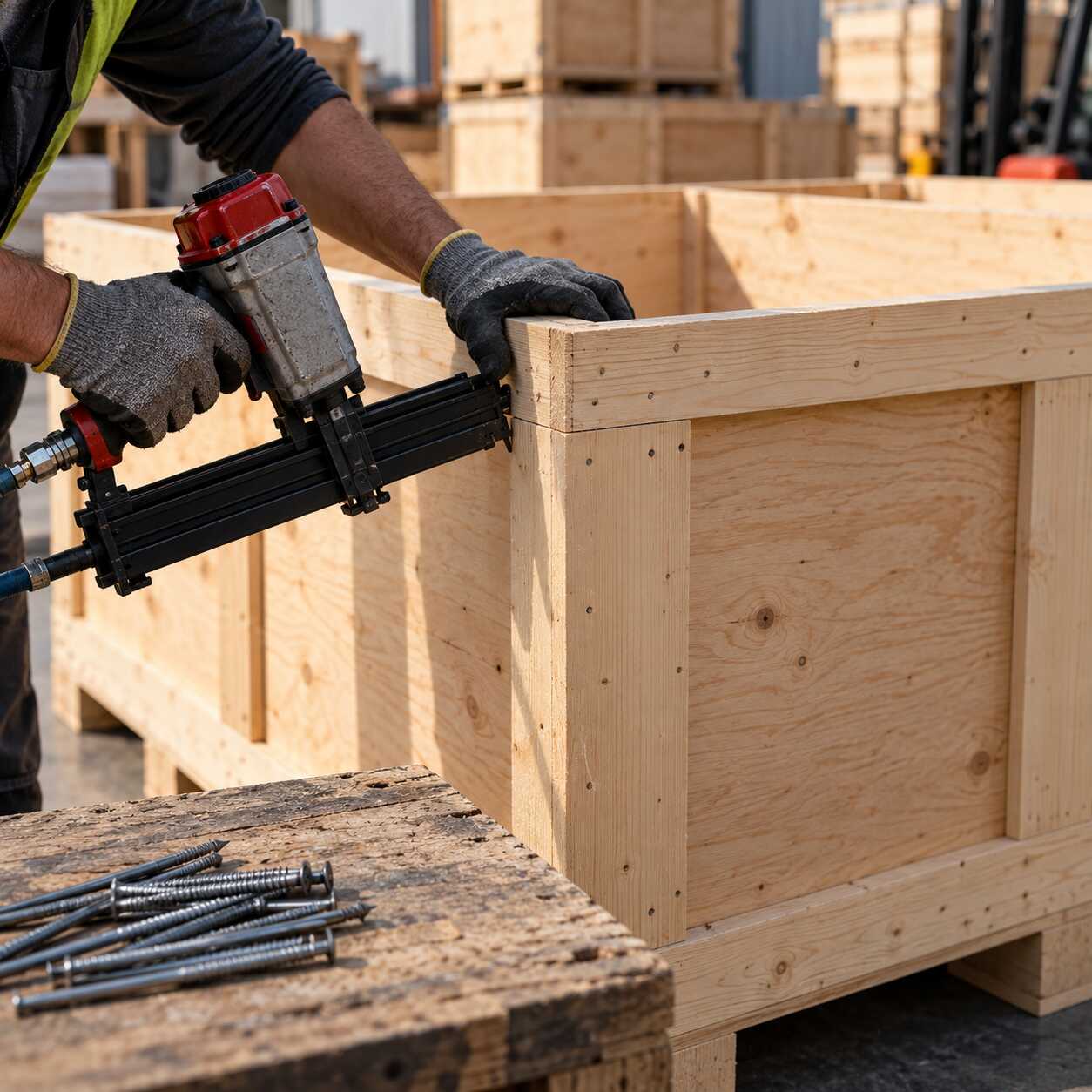
Fasteners and Crate Strength
The strength of a wooden crate depends on more than the quality of its timber or the thickness of its load-bearing members. The fasteners holding the panels, skids, cross members, and supports together also directly affect structural performance. Properly designed joints are particularly important for preserving package integrity when exporting heavy machinery, automotive parts, and industrial equipment.
Wooden crates may use nails, ring-shank nails, screws, and other mechanical fastening solutions. However, different fasteners do not perform equally under all loading conditions. Select fasteners by considering the wood properties, joint location, forces expected during transport, and the crate's intended use.
The Role of Joints in Wooden Crate Strength
Joints allow the different components of a wooden export crate to work together. Their main functions include securing side panels to the base, reinforcing corner joints, and keeping load-bearing supports in position.
Vibration, impact, and changing forces during transport can stress these joints. Incorrect nail spacing, insufficient penetration, or poor installation can increase the risk of wooden components separating.
Selecting Ring-Shank Nails and Mechanical Fasteners
A ring-shank nail has annular ridges along its shank that are intended to resist withdrawal from wood. It may be considered for applications where resistance to loosening is important.
Suitability depends on more than the ring profile. Nail diameter, length, material, and installation method also affect joint performance. Select fasteners based on the expected loads and production requirements.
Key Inspection Criteria for Wooden Crate Joints
- Fastener type: Identify the joint and expected load type before selecting nails or screws.
- Fastener spacing: Plan fastener distribution according to panel dimensions and construction details.
- Wood integrity: Check for splitting and edge damage during installation.
- Installation quality: Verify that fasteners are correctly positioned and driven to a suitable depth.
- Loading conditions: Assess mechanical effects expected during lifting, stacking, and transport.
Why Fastener Quality Matters in Export Crate Production
Preparing a fastening plan alongside the technical drawings for a custom wooden crate helps standardize assembly. In crates carrying heavy loads, carefully assess the joints between the load-bearing base and side structure.
For corporate export operations, define fastener material properties, installation methods, and quality inspection criteria before production. Correctly selected and installed fasteners help the wooden crate maintain its structural integrity during storage, loading, and international transport.
What Is a Ring-Shank Nail?
A ring-shank nail is a nail with annular ridges along its shank, designed to increase withdrawal resistance in wood joints. Also called an annular-ring nail, it may be used in wooden crate production, pallet manufacturing, and industrial packaging. Unlike a conventional smooth-shank nail, its ridged profile helps create mechanical grip in the wood and may help limit loosening at the joint during use.
Using ring-shank nails in export crates is intended to join the packaging in a way that suits its transport conditions. Joint strength, however, depends on more than the nail type. Wood density and moisture, nail dimensions, and installation method also affect performance.
Structural Features of Ring-Shank Nails
The defining feature of a ring-shank nail is the series of annular ridges spaced along its shank. When driven into wood, these ridges create mechanical resistance within the material. This profile matters particularly when a nail is subjected to withdrawal forces along the direction of the joint.
Ring-shank nails are available in different diameters, lengths, and surface finishes. Select dimensions based on the thickness of the wood components being joined and the required joint performance. Not every ring-shank nail is suitable for every wooden crate application.
Ring-Shank Nails Compared with Smooth-Shank Nails
Smooth-shank nails derive much of their joint performance from friction and mechanical interaction with the wood. The ring profile of a ring-shank nail is intended to provide additional grip against withdrawal.
Do not assume that a ring-shank nail will provide greater strength than a smooth-shank nail under every loading condition. Shear forces, the wood's tendency to split, and joint geometry must also be assessed.
Uses of Ring-Shank Nails in Wooden Crate Production
- Side-panel joints: May be considered for securing crate walls to load-bearing members.
- Base joints: May help join wooden components under suitable loading conditions.
- Pallet construction: Can be used for connections between load-bearing members.
- Support components: May be used to secure auxiliary wooden members.
- Industrial packaging: Can be considered for joints exposed to vibration and handling.
Technical Considerations When Selecting Ring-Shank Nails
When selecting ring-shank nails for custom wooden crates, consider product weight, crate construction, and transport method. An unsuitable nail diameter or length can reduce joint performance. Fasteners installed too close to a wood edge may also cause splitting.
For corporate export packaging, specify where ring-shank nails will be used in the technical drawings and assembly instructions. Applying fasteners with suitable equipment and inspecting them during production helps preserve the wooden crate's structural integrity.
Impact and Vibration Resistance
Impact and vibration resistance are important performance criteria affecting how well wooden crates protect industrial products throughout shipment. Road conditions, transfer operations, and forklift movement can apply varying forces to packaging, especially when transporting machinery, automotive parts, and heavy equipment. Choosing ring-shank nails and other fasteners appropriately for these conditions helps preserve the integrity of the wooden crate structure.
Vibration during transport can repeatedly stress joints, while sudden impacts can generate high forces over a short period. Because these effects are mechanically different, joint design should not be assessed solely by the crate's static strength.
How Transport Vibration Affects Wooden Crate Joints
Wooden export crates may experience different vibration conditions during road, sea, and multimodal transport. Repeated movement can increase the risk of loosening at panel joints and load-bearing connections. The nail's withdrawal resistance in the wood matters particularly where a joint is stressed in the withdrawal direction.
The annular profile of a ring-shank nail is intended to provide mechanical resistance to withdrawal. However, joint behavior under vibration depends on nail dimensions, wood properties, and joint geometry.
Maintaining Joint Integrity Under Impact Loads
Sudden movements can occur during forklift lifting, vehicle loading, and transport. They can apply forces in different directions to the crate base, corner joints, and support members.
Assess nail quantity, spacing, and edge distances as well as nail selection to achieve adequate joint strength. Poor installation can cause damage such as wood splitting or fasteners pulling out.
Inspection Criteria for Impact and Vibration Resistance
- Fastener layout: Nail spacing and joint locations should follow the technical design.
- Material compatibility: Match ring-shank nail dimensions to the wood thickness and properties.
- Installation quality: Check for missing, bent, or incorrectly installed fasteners.
- Transport conditions: Assess the number of transfers and expected mechanical effects.
- Product restraint: Separately inspect supports that limit movement inside the crate.
Strength Planning for Industrial Export Crates
For custom wooden crates, plan fastener placement together with product weight and shipping method. For heavy machinery, note that base connections and side-panel joints may not experience the same stresses.
Where appropriate for corporate export operations, consider suitable transport simulations or performance tests. Ring-shank nails alone do not guarantee impact and vibration resistance; the wood, construction, fastener layout, and product restraint system must be assessed together.
Safe Assembly for Heavy Loads
When transporting heavy loads, wooden crate assembly is critical to transferring product weight evenly to the supporting structure and maintaining joint integrity throughout shipment. Select ring-shank nails, screws, and other mechanical fasteners according to the technical requirements of export crates built for industrial machinery, engine assemblies, and heavy equipment. Safe assembly depends not simply on adding more fasteners, but on designing the load transfer correctly.
Determine the product's gross weight, center of gravity, and support points before building the wooden crate. Fasteners hold structural components in position and resist forces at the joints. Transfer the product's weight through load-bearing wooden members and suitable support surfaces, rather than relying on nails alone.
Planning the Load-Bearing Base and Joints
For heavy-load wooden crates, assess base skids, cross members, and product restraint points together. Bending and shear forces generated during forklift lifting can stress joints in different ways.
Ring-shank nails may be used in suitable wood joints where withdrawal resistance is important. They are not, by themselves, a sufficient solution for every high-load connection. Where necessary, consider bolted joints, metal connection plates, or other fastening methods determined by engineering calculations.
How Assembly Errors Affect Structural Safety
An incorrect nail length, insufficient edge distance, or uncontrolled installation force can split the wood and reduce joint strength. Differences in grain direction and wood moisture can also affect fastener performance.
Position fasteners according to the technical drawings, particularly at crate corners and load-bearing joints. Do not assume that damaged components can be reinforced simply by adding more nails.
Safe Assembly Checklist for Heavy Loads
- Load information: Verify gross weight and center of gravity.
- Support system: Inspect the position of skids, cross members, and supports.
- Fastener selection: Define whether ring-shank nails, screws, or bolts are appropriate for each use.
- Installation layout: Check fastener spacing, penetration, and edge distances.
- Final inspection: Correct splits, loose joints, and missing fasteners.
Production Approval and Shipment Preparation
For custom wooden crates, prepare the assembly plan alongside the product drawings and lifting method. Qualified technical personnel should perform any required calculations and compliance checks for critical joints.
Keeping assembly records and quality inspection results traceable supports standardized production in corporate export operations. Correct installation of ring-shank nails and other fasteners helps ensure that the wooden crate structure can be used safely during storage, forklift handling, and international transport of heavy loads.
Comparison with Screw Fastening
Ring-shank nails and screw fastening systems are mechanical solutions for different assembly and use requirements in wooden crate production. For export crates used to transport industrial equipment in particular, select fasteners based on transport loads, production time, disassembly needs, and packaging service life. Both systems have advantages, but one fastening method is not appropriate for every wooden crate application.
The ring profile of a ring-shank nail is intended to provide mechanical grip against withdrawal. Threaded screws secure wooden components through their threads. Actual joint strength, however, depends on fastener dimensions, wood properties, and the forces acting on the joint.
Technical Differences Between Ring-Shank Nails and Screws
Ring-shank nails may be suited to high-speed assembly with appropriate nailing equipment. This can help manage production time when manufacturing large quantities of wood packaging. Nail penetration depth, spacing, and potential splitting of the wood still need to be checked.
With a suitable design, screw fastening can allow controlled assembly and, when needed, disassembly. It may be advantageous for crate panels that must be opened for maintenance. The screw type, pilot-hole preparation, and tightening method are important during installation.
Comparing Durability and Disassembly
The ring profile can improve withdrawal resistance while making a ring-shank nail more difficult to remove. Screw connections may allow more controlled disassembly, depending on their condition. Repeated removal and reinstallation can nevertheless change the wood's holding properties.
The more suitable fastener under shear loads, impact, or vibration cannot be determined by fastener type alone. For critical joints, assess manufacturer data and technical calculations.
Selecting a Fastening System for Wooden Crates
- Volume production: Assess assembly speed and equipment suitability.
- Reuse: Determine whether the crate needs to be opened and closed repeatedly.
- Transport loads: Assess withdrawal and shear forces separately.
- Material properties: Consider wood thickness, density, and moisture.
- Maintenance: Plan how damaged fasteners will be replaced.
Combining Fastening Methods in Export Crates
Custom wooden crates can use ring-shank nails and screws in different parts of the same structure. Permanent panel joints and removable lid connections, for example, may call for different assembly methods. The choice should suit the product's weight and shipping conditions.
For corporate packaging procurement, specify the fastener type in the technical drawing and production specification. Whether a joint meets its expected performance depends not only on material selection, but also on installation quality and post-production inspection.
Reusable Trade Show Crates
Reusability is an important factor that directly affects the design of trade show crates. Industrial machinery, promotional equipment, and display products may be shipped repeatedly to different events. In these cases, it is not enough for a wooden crate to withstand its first shipment; it must also retain its structural integrity after opening, closing, loading, and unloading. Select ring-shank nails, screws, and other fasteners for the intended reuse scenario.
When designing a reusable wooden crate, distinguish permanent load-bearing joints from removable panels. Since not every joint needs to be disassembled repeatedly, assembling the entire structure with the same fastening system may not be operationally suitable.
When Trade Show Crates Need Removable Fasteners
During trade show transport, parts of a crate may need to be opened so products can be placed in the display area. Side panels or lids can be designed for removal based on the product's dimensions and the method used to take it out.
With suitable design and installation, screw fasteners can make these operations easier to control. Ring-shank nails may be considered for load-bearing joints that are not intended to be disassembled. The main criterion for selecting a fastener is the function of the part throughout its service life.
Fastener Durability During Reuse
Each reuse cycle involving forklift lifting, vehicle loading, and storage can wear crate joints. Inspect screw holes and wood surfaces, particularly when reinstalling panels that have been removed.
Replacing loosened fasteners with larger ones is not always appropriate. Assess the condition of the wood, the location of the joints, and the expected loads together.
Inspection Criteria for Reusable Trade Show Crates
- Removable panels: Identify which parts of the crate need to be opened during the design stage.
- Fastener selection: Assess permanent joints separately from points that will be reopened.
- Assembly inspection: Inspect screw holes, ring-shank nails, and corner joints.
- Load-bearing base: Verify the integrity of forklift entries and support members.
- Storage conditions: Manage the risks of moisture, impact, and deformation.
Maintenance and Reuse Planning After a Trade Show
Before reusing a wooden crate after a trade show, inspect its physical condition. Record damaged panels, loose joints, and deformation in load-bearing members. For international shipments, also assess applicable ISPM 15 repair and re-marking requirements for solid wood components.
Tracking packaging use history in corporate trade show logistics helps plan maintenance. Selecting ring-shank nails and screw fasteners for their intended purposes helps manage a trade show crate's reuse potential alongside technical and operational requirements.
Quality Control Stages
Quality control in wooden crate production is a systematic process for verifying that fasteners are correctly selected and the load-bearing structure is assembled to technical requirements. Joints made with ring-shank nails, screws, and bolts should be assessed against defined criteria from material receipt through final product inspection. Detecting fastener defects during production, especially for exports of heavy machinery and industrial equipment, helps reduce the risk of damage and repackaging during shipment.
Incoming Material and Fastener Inspection
Before production begins, inspect the dimensions and visible defects of wooden components and confirm their suitability for the intended use. Check the diameter, length, and surface condition of ring-shank nails and other fasteners against the order specification. Fasteners of the wrong dimensions can adversely affect joint strength.
Keep incoming material records traceable by supplier, product description, and, where available, batch information. Clearly specify the fastener properties for critical joints in the approved technical drawings.
Installation Checks During Assembly
Install nails and screws in the correct positions when assembling a wooden crate. Check fastener spacing, edge distances, and penetration depth. Correct bent nails, splits in the wood, or missing fasteners before production is complete.
The withdrawal-resistance benefit of a ring-shank nail does not compensate for incorrect installation. Equipment settings and installation methods should be treated as production variables that affect joint quality.
Wooden Crate Quality Control Checklist
- Material suitability: Do the timber dimensions and fasteners match the specification?
- Assembly layout: Are nail and screw positions consistent with the technical drawing?
- Joint integrity: Are there any loose joints, splits, or missing fasteners?
- Support structure: Are the base, skids, and cross members correctly connected?
- Removable components: Has the opening method for lids and panels been verified?
- Final acceptance: Have identified deficiencies been corrected and recorded?
Final Product Inspection and Traceability
After assembly, compare the crate dimensions, support structure, and joints with the shipping specification. Where necessary, plan a technical assessment or suitable performance tests for critical joints. A visual inspection alone does not prove that every joint can withstand transport loads.
For reusable trade show crates, separately inspect how previous disassembly and transport have affected the joints. For international shipments, include applicable treatment and marking requirements for wood components within the scope of ISPM 15 in the inspection process.
Shared acceptance criteria among production, quality, and logistics teams make it easier to identify the source of defects and track corrective actions. Recorded quality control stages help ensure wooden export crates are produced for their intended conditions of use.