
 Türkçe
 English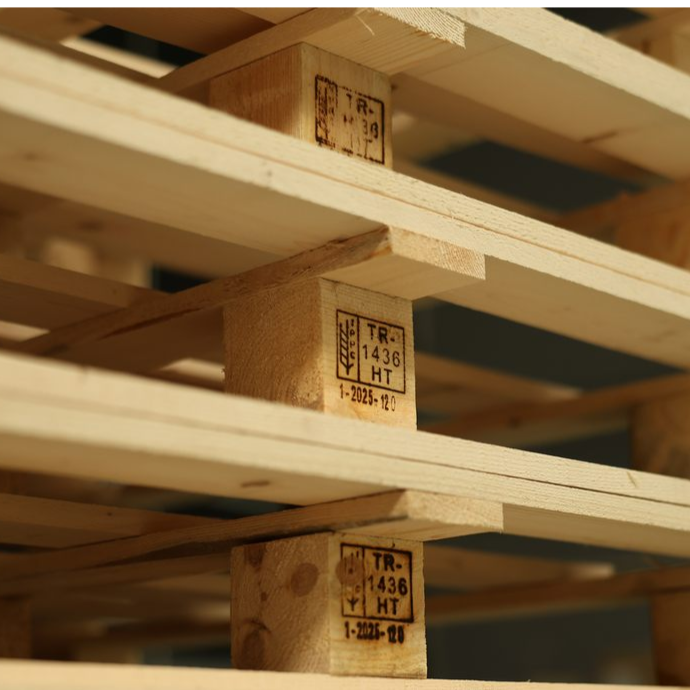
Meaning of the IPPC Mark
The IPPC mark is a standardized marking system identifying solid-wood packaging used in international trade as having undergone an accepted phytosanitary treatment under ISPM 15. When solid-wood components used in export crates, pallets, open-frame cases, reels, skids, and load restraints pass through the appropriate process, an authorized operator may apply this mark. Its main purpose is to provide traceability for measures that reduce the risk of pests being transported between countries in wood. The mark does not by itself indicate commercial timber quality or structural capacity; it links the phytosanitary treatment to the authorized producer or treatment provider.
IPPC stands for the International Plant Protection Convention, represented by the wheat-like symbol in the mark. Beside it are a two-letter country code, a unique code assigned to the producer or treatment provider, and an abbreviation for the treatment applied. Under ISPM 15, the country identifier is a two-letter ISO code and the operator code is assigned by the country’s national plant protection organization. Treatment codes such as HT identify the accepted treatment used. Every component carries separate information, so the IPPC symbol alone does not verify that all requirements have been met.
The relationship between IPPC marking and ISPM 15 arises from the phytosanitary risks associated with raw solid wood in international trade. Without proper treatment, pests beneath the bark or within the wood may reach new regions along the transport route. The standard is based on suitable wood, an accepted treatment, and an internationally recognizable mark on the completed packaging. Inspectors can therefore read the codes without requiring a separate explanation for every crate. The mark supports inspection but does not eliminate physical examination or country-specific import controls.
Assess every component of an export crate. Even where external panels are plywood or OSB, solid wood may be present in base skids, cross-members, uprights, or internal blocks. These components matter for ISPM 15 evaluation. Looking only at external panels may produce an incomplete decision, especially for heavy machinery where thick base members and restraint blocks are hidden but structurally critical.
Do not interpret the IPPC mark as a quality logo, brand emblem, or general export approval. It identifies a specific phytosanitary treatment and the authorized operator responsible for it. Structural capacity, internal restraint, moisture protection, container compatibility, and transport durability require separate engineering checks. A correctly marked but underdesigned crate is not mechanically safe; a strong crate that fails treatment and marking requirements may still be noncompliant at border inspection.
For international recognition, the mark must be visible, legible, permanent, and not hand-drawn. ISPM 15 provides for a rectangular or square border and a vertical line separating the IPPC symbol from the codes. Its size is not fixed, but it must be readable without visual aids. Do not add unrelated commercial information within the border or alter the code meaning. Company logos, product details, and handling marks may be placed outside it.
After repair, remanufacture, or modification, do not assume that an existing IPPC mark remains automatically valid. Adding unmarked or unverifiable solid wood can compromise integrity and traceability. Replacement skids, new blocks, and combinations of components carrying different marks must be managed under authorized procedures. A visible mark on used packaging does not prove current structural condition or absence of modifications. Inspect both the wood and marks before reuse.
What Does the IPPC Mark Provide?
It indicates that solid-wood packaging received an accepted ISPM 15 treatment and can be associated with an authorized producer or treatment provider. Mechanical strength and product protection must be verified separately.
When ordering a heat-treated export crate, verify not only that a mark exists but also that its codes are correct, legible, and consistent with the components. Before shipment, check solid-wood eligibility, treatment code, authorized-operator details, and visibility. Sharing the destination, transit route, and customer requirements at quotation stage supports appropriate planning. Correct interpretation of the mark connects the crate, ISPM 15 treatment, and customs control while reducing delays and repacking caused by faulty marking.
TR Code and Facility Number
The “TR” code on an IPPC mark is the two-letter country identifier showing that the authorized operator responsible for marking the packaging is registered in Türkiye. It does not identify the company name, city, or destination country. An appropriately marked package from an authorized producer or treatment provider in Türkiye is expected to carry TR, but TR alone does not establish a complete or valid mark.
The facility or operator number beside TR identifies the authorized organization connected with production, heat treatment, and marking. It is not a self-selected serial number; it is uniquely assigned within the official system. Different operators in the same city receive different numbers. This identifier provides traceability and forms part of the control mechanism against unauthorized use.
Read the country and facility information together. A separator may appear between TR and the assigned operator code, while HT follows within the prescribed arrangement. Layout may vary with the stencil and surface, but code order and meaning must remain clear. Faint, incomplete, or overlapping characters can make the facility unreadable. Select an appropriate area on rough timber and verify that every character transfers correctly.
The facility number is not the commercial order or invoice number. Order, batch, project, and product references serve commercial tracking and cannot replace the officially assigned operator code. Place customer names, logos, shipment numbers, and destinations outside the IPPC border so they do not obscure or distort the standard mark.
A missing, unreadable, or mismatched facility number can create doubt during inspection. Even one missing character may prevent identification. Different operator codes on different faces can suggest repair or assembly from mixed sources. Old marks on reused components must not be treated as current production information; repairs and reuse require control under authorized procedures.
The traceability function requires consistency between marked wood and production records. The production or treatment group, material eligibility, and treatment conditions should be traceable internally. Applying a mark to the finished crate without the underlying controls is insufficient. Authorized operators must prevent uncontrolled use of their assigned code and restrict marking to defined personnel and processes.
Exporters can perform a practical pre-loading check: confirm the two-letter country code, complete facility code, and correctly positioned HT code. Check before closure, wrapping, or container loading hides the mark. Photographs can support shipment records, but they do not replace physical verification of the mark and solid-wood components.
Reading the TR and Facility Codes Together
TR links the mark to an authorized operator in Türkiye; the facility number identifies the specific producer or treatment provider responsible. The following HT code identifies the treatment applied.
When ordering heat-treated export crates, assess authorization to use the mark, legibility of TR and the facility code, and consistency with production records. State destination, transport method, and ISPM 15 requirements at quotation stage. Solid-wood bases, cross-members, uprights, and blocks must remain within the same control system. Correct coding helps border authorities identify source and reduces unauthorized, mixed, or untraceable marking risks.
What Does the HT Treatment Code Indicate?
The “HT” code in the IPPC mark indicates conventional heat treatment accepted under ISPM 15. It abbreviates “Heat Treatment” and follows the country and authorized-facility codes. It applies to solid wood used in export crates, pallets, open-frame cases, base skids, and restraint blocks treated under the specified temperature and time conditions. HT is not an independent commercial quality statement and must appear within the standard mark together with the IPPC symbol and identification codes.
The core requirement for conventional heat treatment is a minimum temperature of 56°C throughout the entire wood profile, including its core, maintained continuously for at least 30 minutes. A brief furnace-air reading of 56°C does not prove that the center of the timber reached the requirement. Thick skids heat more slowly than thin boards. Programs must therefore account for species, thickness, initial temperature, moisture, and airflow, and HT may be used only after successful completion.
Monitor the slowest-heating area. Stack timber to permit airflow, place measurement points in representative locations, and ensure sensors correctly track core temperature. Do not begin the time calculation before the required core temperature is reached. Record values at defined intervals to identify drops or interruptions. If conditions are not met, do not assume completion; apply the prescribed corrective process.
Heat treatment and kiln drying may be related, but they are not identical. A drying cycle qualifies as HT only if it verifies the required time and temperature. Dry appearance or low moisture does not by itself prove compliant treatment. HT does not state moisture content or water resistance; dimensional stability, package humidity, and corrosion protection remain separate technical matters.
Packaging may be treated after assembly or manufactured from appropriately treated timber, but every solid-wood component must remain eligible. Adding unmarked or unverifiable blocks, uprights, or supports later undermines traceability. Separate treated and untreated stock, track offcuts after cutting, and keep every solid-wood addition within the same control approach.
HT differs from codes such as MB for methyl bromide treatment and DH for dielectric heating. Use the code that matches the actual treatment. Habitually applying HT to other processes does not provide traceability. Correct order and clear characters allow inspectors to identify the method quickly; faint, incomplete, or confused codes may trigger further inspection.
HT reduces phytosanitary risk but does not demonstrate mechanical strength or comprehensive logistics protection. Base sections, forklift entries, internal restraints, moisture barriers, and container compatibility require separate design. A thin heat-treated base does not automatically carry heavy machinery, and an HT-marked crate is not waterproof.
Core Message of the HT Code
HT indicates conventional heat treatment in which at least 56°C is maintained continuously for at least 30 minutes throughout the entire solid-wood profile, including its core.
When purchasing a heat-treated export crate, do not rely solely on the letters HT. Verify that the complete, legible mark includes the IPPC symbol, TR code, and authorized facility number, and that skids, cross-members, uprights, and blocks come from the eligible material group. Linking production and treatment records to the order makes the treatment traceable.
Positioning the Mark on the Wooden Crate
Positioning determines whether customs, port, and border inspectors can easily see the IPPC mark. Treated timber alone does not support efficient control; the mark must be readable and accessible. Avoid downward-facing surfaces, areas hidden by the product, and forklift-wear zones. Consider shipping orientation, container placement, and accessible faces, and place the mark permanently on structural elements where it remains legible throughout transport.
Where possible, mark two opposite vertical faces of the completed packaging unit. If one face is close to a container wall or another load, the opposite mark may remain accessible. Not every wooden part needs a separate mark; the mark identifies the completed unit. For modular designs, make clear which unit each mark represents and avoid ambiguity from removable components.
Surface condition directly affects legibility. Rough, cracked, knotted, or dirty wood may leave characters incomplete. One missing digit in the facility number or letter in HT can prevent interpretation. Select and, where appropriate, prepare a suitable surface; apply sufficient contrast and verify the symbol, country code, facility number, and treatment code separately after marking.
The mark must sit within a rectangular or square border with a vertical line separating the symbol and codes. No single size applies to every crate, but characters must be readable without visual aids. A tiny mark may disappear on a large face, while compressing it onto narrow timber can distort characters. Select size for the available surface and viewing distance.
Whether the mark is applied to a panel or a solid structural member depends on construction. A removable panel may separate the mark from the completed unit, while thin cladding may be replaced after damage. Base or permanent uprights may retain it longer but must remain visible. A panel mark does not itself demonstrate eligibility of hidden solid wood; marking and production records must remain consistently linked.
Place handling labels, product data, logos, lifting symbols, and center-of-gravity marks elsewhere. Commercial data within the IPPC border distorts the standard design, while barcodes and metal bands may cover characters. Plan all labels and straps in advance so the IPPC mark remains independent, clean, and readable.
Permanent means resistant to normal handling and transport. Adhesive paper labels may detach through moisture, friction, or dirt, while hand-drawn or easily altered markings are unreliable. Stamps, stencils, or suitable printing can standardize codes, provided the method does not scorch, bleed, or obscure them. Production-stage inspection allows defective marks to be corrected under authorized procedures before container loading.
Suitable Mark Location
Where possible, apply the IPPC mark to smooth, permanent, readily visible areas on two opposite vertical faces. Wrapping, labels, straps, and other loads must not prevent it from being read.
Before shipment, walk around the crate and check mark location, number, and legibility. Confirm that TR, facility number, and HT are fully visible and reposition any wrapping or label that would cover them. Preserve visibility on the accessible side in the container plan. Photographs may support tracking. Correct placement enables faster recognition and reduces additional inspection caused by poor visibility.
Risks of Fraudulent or Incomplete Marks
A fraudulent, unauthorized, incomplete, or illegible IPPC mark can cause compliance to be questioned at customs and border inspection. The mark identifies accepted phytosanitary treatment and the responsible authorized operator. Random use of the symbol, another operator’s code, or HT without treatment destroys traceability and can affect the exporter’s schedule, transport plan, and customer relationship as well as the packaging supplier.
An incomplete mark lacks or obscures a required element. The symbol without TR, facility number, or HT is not complete. Faint printing, cracks, strapping, small size, and rough surfaces can prevent verification. Inspect every applied mark during production.
The risk begins when the mark is treated as a visual logo rather than the visible component of authorization, treatment records, material control, and traceability. Downloading a symbol or using an unassigned code provides no compliance. Verify the supplier’s authority and supporting treatment records rather than merely checking for a stamp.
Multiple old marks from different countries or operators create uncertainty about reuse and repair. Timber recovered from marked pallets may make an old mark appear to represent new production, while unmarked repair wood can invalidate the old mark’s representation. Manage reuse and repair through defined controls and do not assemble uncontrolled low-cost wood from mixed sources.
When inspectors find a noncompliant mark, a shipment may undergo additional examination. Depending on destination rules and the defect, measures can include retreatment, transfer to another crate, separation, return, or destruction. Port storage, labor, replacement packaging, vehicle arrangements, and delivery delays can far exceed initial savings.
Visibility can be lost after production through stretch film, covers, labels, metal bands, restraints, fork abrasion, dirt, or moisture. Applying marks to two protected vertical faces and checking immediately before loading helps identify these issues.
Exporters should verify the symbol, TR, authorized facility number, and HT together; check consistency between faces; inspect solid-wood additions; and link treatment records to sales and shipment data. Order-level verification is safer than relying on a verbal declaration.
Controls That Reduce Marking Risk
Read the IPPC symbol, TR, facility number, and HT together; confirm the authorized operator, eligible source of solid-wood components, and continued mark visibility.
Before loading, verify authenticity, completeness, and visibility against production records. Resolve unreadable or contradictory codes with the authorized producer before container loading. Assess any field-added blocks, skids, or supports. Supplier controls, photographic shipment records, and order-based traceability help identify fraudulent marks, old components, and missing codes early.
Relationship with Export Documents
The relationship between the IPPC mark and export documentation depends on consistency between the physical packaging mark and commercial and operational records. The mark displays country, authorized facility, and treatment directly on the crate, pallet, or case, but it does not replace the commercial invoice, packing list, transport document, or customs declaration. Documents describe the commercial movement of goods; the IPPC mark identifies phytosanitary treatment of solid-wood packaging.
Direct marking allows packaging to be inspected at border crossings without a separate explanation for every unit. Destination law, customer procurement terms, carrier rules, or shipment type may nevertheless require additional records. Check requirements for the actual destination and route. An IPPC mark does not automatically complete other commercial or customs obligations.
Maintain a traceable connection among treatment reports, temperature charts, invoices, and order data. Treatment date, batch, and authorized-operator information should be relatable to the facility code on the crate. Where a heat-treatment report or chart is managed with the sale, exporters should check consistency with the physical mark. Records from a different facility weaken traceability.
A clear invoice description helps define the purchased service. Heat treatment, IPPC marking, internal restraint, barrier protection, and field packing may be identified separately. The phrase “heat-treated crate” on an invoice cannot compensate for a missing or unreadable physical mark, and a mark cannot cure missing commercial or treatment records. All should refer to the same order.
Packing lists may show package quantity, crate numbers, contents, net and gross weight, and external dimensions. These do not replace the facility code but help link each crate to shipment records. Give each crate a unique shipping number outside the IPPC border. Alignment with packing-list rows speeds content and gross-weight checks.
Bills of lading, road consignment notes, and air waybills describe transport while the mark remains on the physical surface. It must remain visible at ports and borders even where documents are electronic. Container orientation that hides every mark may require load rearrangement. Photographs showing crate number and mark can support operations but do not replace official records or physical marking.
If destination authorities request more information, the exporter must be able to reach the producer and records. TR and the facility number identify the responsible operator, while the order number can locate the production group. Mismatched batches, dates, or producer details increase inspection risk. Retain consistent records through shipment and link product name, crate number, treatment date, and shipment reference.
Consistency Between Physical Marks and Documents
The TR code, facility number, and HT mark should be linkable to treatment records, order information, invoice, and crate number. Commercial documents and the IPPC mark do not replace one another.
Before export loading, review the physical mark, production or treatment record, invoice scope, packing list, and transport data together. Verify package count, external dimensions, and gross weights, and resolve differing facility codes or missing marks. Obtain current destination requirements from the customs representative, carrier, and consignee. Consistent traceability reduces delays caused by information discrepancies.
Control Points in the FirstPack Production Process
At FirstPack, control of an IPPC-marked, heat-treated export crate is not limited to final visual inspection. Sequential checkpoints extend from product data and material selection through base design and marking. Incorrect weight distorts the base; an omitted destination undermines treatment planning; missing transport data can produce unsuitable external dimensions. The process therefore begins by validating quotation inputs.
The first checkpoint assesses shipping-position width, length, height, net weight, and base contact zones. Machine feet, chassis connections, center of gravity, sensitive surfaces, projections, and accessories are transferred to the plan. Container type, vehicle, forklift-entry direction, and destination are clarified. Separating internal and external dimensions supports both product clearance and logistics compatibility.
Material acceptance and stock segregation are fundamental. Verify that solid-wood skids, cross-members, uprights, and blocks belong to the correct treatment group and do not mix them with unknown or untreated stock. Although plywood and OSB are assessed separately, every solid-wood component remains traceable. Track components after cutting and reject damaged, excessively cracked, or structurally unsuitable pieces even if treated.
During heat treatment, monitor the slowest-heating zone. Thick skids may take longer than thin supports to reach core temperature. Loading must support airflow, sensor locations must represent the batch, and measurements must be recorded. Do not start the duration before reaching the required temperature; reassess interruptions or drops under defined controls.
Base and restraint controls support mechanical safety alongside IPPC compliance. Size main skids for weight, position cross-members beneath load-transfer points, and match forklift channels to equipment. Use eligible treated solid wood for blocks and supports and do not add unknown components later. Apply bolts, bands, and protective interfaces according to plan, then verify restraint without pressure on sensitive surfaces.
At marking, verify the IPPC symbol, TR code, authorized facility number, and HT code in the correct arrangement. Apply marks where possible to smooth, visible areas on two opposite vertical faces. Reject faint, cracked, or incomplete impressions. Plan logos, customer labels, straps, and handling symbols so they do not cover marks, and link each physical mark to the treatment and production record for the same order.
Pre-shipment control covers external dimensions, gross weight, forklift entries, panel connections, and marks. Adjust stretch film, tarpaulins, or other protection if they hide the mark. Match crate numbers to shipment contents and check each unit separately. Confirm container-door dimensions and loading direction. Photographs of marks, restraints, and the closed crate may support order tracking.
Integrated Control from Production to Shipment
FirstPack treats product data, eligible materials, heat-treatment monitoring, base strength, internal restraint, IPPC marking, and shipment inspection as complementary stages.
When requesting a heat-treated export crate from FirstPack, provide product dimensions, net weight, orientation, destination, container type, and delivery date. Also identify sensitive surfaces, special protection, field packing, and customer packaging conditions. These inputs support correct marking, linkage of HT to the relevant production group, and structural design for weight. Control from production through loading anchors customs assurance in traceable materials and verified construction, not merely a visible mark.