
 Türkçe
 English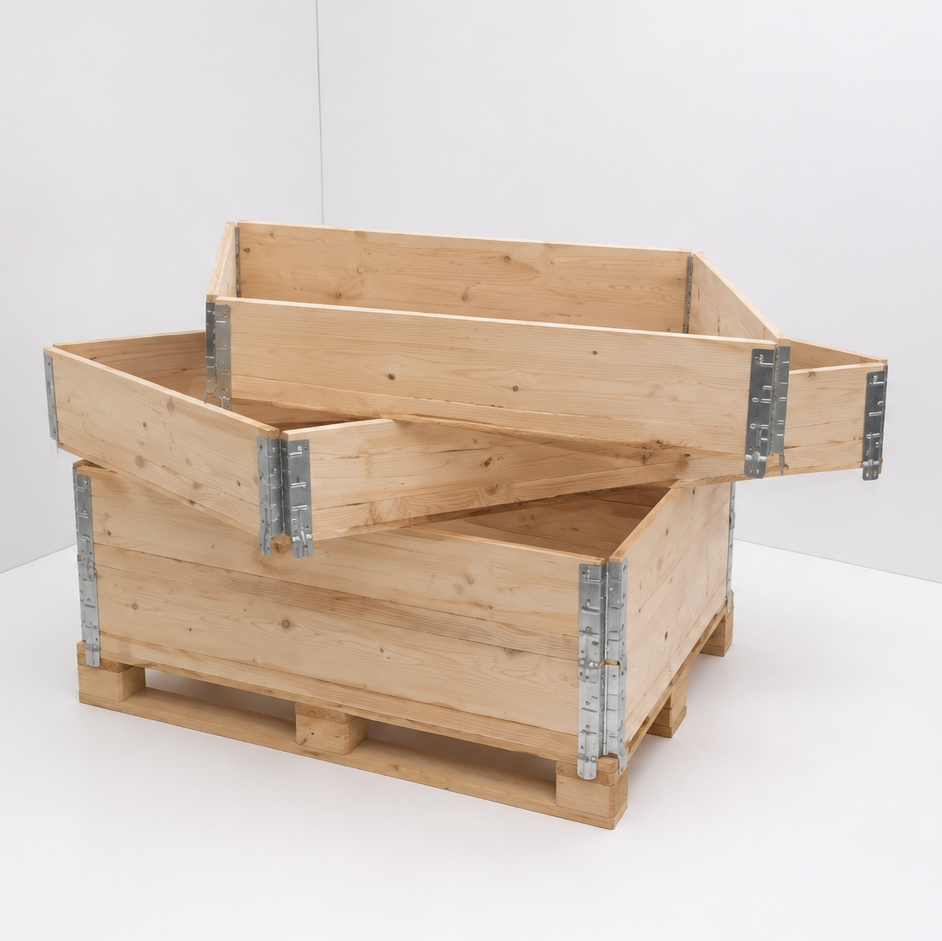
How a Collapsible Plywood Crate Works
A collapsible plywood crate consists of a load-bearing base, foldable or removable side walls, and a top cover. When assembled, these components create a rigid packaging unit; after unloading, the body can be folded flat onto the base or separated into a compact return pack. This working principle reduces the volume occupied when the crate is empty without sacrificing the controlled enclosure required during transport.
The base remains the primary structural component. Main skids, cross-members, floor panels, and product restraints transfer weight to forklift forks and the transport floor. The folding body does not carry heavy product loads by itself. Base capacity must therefore be designed from net product weight, contact points, chassis geometry, and center of gravity, just as it would be for a fixed wooden crate.
The side-wall system commonly uses plywood panels combined with hinges, steel profiles, locking tabs, clips, or removable fasteners. Connections must keep the walls aligned under vibration and handling forces while allowing controlled folding after use. Hardware selection affects assembly speed, service life, maintenance, and the number of reuse cycles.
The lid closes the assembled crate and may also stabilize the upper edges. It must remain secure during transport but be removable without damaging the folding mechanism. Where stacking is required, the lid alone must not carry the upper load; forces should transfer through designed corner posts, frame members, and the base below.
Assembly normally begins by placing the base in the packing area, raising and locking the walls, installing internal protection, positioning the product, applying restraints, and fitting the lid. At destination, the process is reversed in a controlled sequence. Clear markings and standardized hardware reduce assembly errors and training requirements.
Internal restraints remain product-specific. Blocks, bolts, straps, compartments, and protective interfaces should attach to durable product and base locations. The ability to fold the shell does not replace structural restraint. For reusable programs, modular supports may be changed while the standard base and body remain in service.
Folded dimensions must include the base, nested walls, lid, protruding hardware, and any return packaging. A theoretical panel thickness alone understates actual collapsed height. Measure the complete folded pack so storage racks, return vehicles, and handling methods can be planned accurately.
Three Core Components of the Collapsible System
The load-bearing base carries the product, the folding plywood body creates the enclosure, and the removable lid closes and stabilizes the assembled crate.
For an accurate quotation, provide assembled and folded dimensions, product weight and geometry, expected reuse count, handling method, stacking plan, route, and required protective measures. A collapsible plywood crate delivers value when its folding mechanism, structural base, and operational process are designed as one system.
Empty-Return Logistics Advantage
The primary empty-return advantage of a collapsible plywood crate is lower volume after delivery. A fixed empty crate occupies nearly the same space as a loaded one, while a folded crate can combine its walls and lid into a shallow unit on the base. More empty packages may therefore fit in one vehicle, container, or internal transport run.
Return efficiency should be calculated from the actual folded external dimensions, not a generic reduction percentage. Hardware, skids, nested panels, protective separators, and securing straps add height. Divide usable vehicle or container space by the verified folded footprint and height while preserving working clearances and weight limits.
Return transport cost depends on distance, route frequency, vehicle type, crate quantity, and whether the returning vehicle would otherwise travel empty. Closed-loop routes with regular deliveries offer the clearest opportunity because folded crates can be collected predictably and returned in batches.
Folded packs must be secured against sliding, opening, and panel damage. Use defined stacking orientation, straps, edge protection, and anti-slip interfaces where appropriate. Loose panels and hardware can become damaged or lost, reducing reuse value.
Return loads are lighter than loaded shipments but still require proper weight distribution. Do not exceed vehicle payload, floor point-load, or stack limits. Place heavier bases low and align structural contact points so upper packs do not crush plywood edges or fittings.
Reverse-logistics planning should identify collection points, responsible teams, return frequency, inspection location, and ownership records. Without a return process, collapsible crates may accumulate at customer sites and fail to generate the expected savings.
Cleaning, inspection, repair, and redistribution may be centralized at the origin or handled at regional hubs. Include these movements and labor in the cost model. A longer return distance can still be viable where crates are valuable, frequently reused, and efficiently consolidated.
Core Data for Empty-Return Efficiency
Use actual folded dimensions, empty weight, stack limit, vehicle capacity, route distance, return frequency, collection volume, and handling cost.
Compare the total return cost per usable reuse cycle with the cost of one-way packaging and disposal. The operational benefit comes from combining volume reduction with reliable collection, inspection, and redeployment—not from foldability alone.
Storage Space Savings
Collapsible plywood crates reduce warehouse space by converting empty assembled volume into compact folded packs. This is particularly valuable where packaging inventory waits before production, between shipments, or after return. Lower storage volume can release floor and rack capacity for products, raw materials, or operational work areas.
Measure savings by comparing the assembled cubic volume with the complete folded volume. Include skids, lid, hardware, panel nesting, and safe spacing. Nominal panel dimensions may overstate savings if the folded unit cannot be stacked tightly or requires protective gaps.
Warehouse design should define dedicated locations for assembled crates, folded clean units, units awaiting inspection, and damaged components. Mixing statuses creates inventory errors and may send an unapproved crate back into service.
Folded packs should have standardized footprints where possible. Consistent sizes improve rack utilization, pallet locations, forklift approach, and stock counting. A large number of unique sizes can reduce the expected storage benefit even when each crate folds.
Stacking must transfer load through the base or engineered contact points rather than plywood edges, hinges, or locking tabs. Use separators or locating features where necessary. Mark maximum stack quantity and orientation visibly.
Keep stored components dry, ventilated, and protected from direct rain or wet floors. Foldability does not make plywood immune to moisture, edge swelling, delamination, mold, or hardware corrosion. Suitable environmental controls preserve reuse life.
Inventory management should record crate identification, size, location, condition, ownership, and cycle count. Barcode or RFID systems may help where large fleets circulate. Better visibility reduces unnecessary purchasing caused by crates being unavailable or unlocated.
Data That Measure Storage Savings
Track assembled and folded volume, units per stack or rack position, inventory quantity, dwell time, floor or rack cost, handling frequency, and damage rate.
Calculate savings over the actual inventory profile, not one crate in isolation. A collapsible system creates the greatest warehouse benefit when crate dimensions are standardized, return timing is predictable, safe stacks are defined, and inventory status is actively managed.
Reusability
Reusability allows the initial crate cost to be distributed over multiple shipment cycles. A collapsible plywood crate can be opened, folded, returned, inspected, and assembled again without the destructive dismantling common to nailed one-way packaging. The economic result depends on actual completed cycles rather than the theoretical possibility of reuse.
Service life is influenced by plywood grade and thickness, base timber, connection hardware, panel edges, moisture exposure, handling quality, product weight, and route severity. Higher initial specifications may be justified where many reliable cycles are expected.
Define inspection criteria for cracks, delamination, swollen edges, bent hardware, loose connections, damaged skids, deformed cross-members, contamination, and missing components. Assign clear accept, repair, and reject decisions to trained personnel.
Product compatibility must be revalidated. A crate designed for one model may not suit another product with different weight, feet, center of gravity, or sensitive surfaces. Modular restraints can expand use across a controlled product family, but base capacity and internal clearances remain limiting conditions.
Repairs should use specified materials and authorized procedures. Improvised panels or unknown solid wood may reduce structural performance and affect export compliance. Replacement hardware must match original load and locking functions.
For international shipments, inspect ISPM 15 implications for solid-wood bases, skids, blocks, and repairs. Existing marks may not represent later unapproved additions. Keep treatment, repair, and traceability records consistent with the current packaging unit.
Cleaning requirements vary by sector. Automotive parts, electronics, food-related equipment, medical production, and precision components may require different contamination controls. Design surfaces and removable inserts for practical cleaning where this is part of the return cycle.
Basis of the Reuse Decision
Reuse only when structural condition, product compatibility, cleanliness, hardware operation, export compliance, and traceability meet the approved criteria.
Track cycle count, inspection findings, repairs, losses, and retirement reasons. Total cost per successful cycle should include purchase, return, storage, handling, cleaning, inspection, repair, and loss. Reusability produces measurable value when these processes are standardized and controlled.
Industry Use Cases
Collapsible plywood crates are particularly effective in recurring supply chains where identical or similar products move between known facilities. Regular routes, predictable return flows, and repeatable packing processes allow folding, collection, inspection, and reuse to operate as a closed-loop packaging system.
Automotive and component manufacturing can use folding crates for engines, gearboxes, fixtures, machined parts, modules, and service components. Standard footprints and modular restraints support production-line supply, while folded returns reduce empty transport and warehouse congestion.
Machinery and industrial-equipment producers may use collapsible crates for pumps, motors, control units, spare parts, and export modules. Heavy machinery still requires a product-specific structural base; the folding shell mainly improves empty storage and return efficiency.
Electronics, automation, and electrical-panel suppliers can benefit from a closed plywood enclosure combined with reusable foam, barrier materials, or modular supports. Sensitive components require controlled contact, vibration protection, and moisture management on every cycle.
Defense, aerospace, energy, and precision manufacturing may use collapsible systems for high-value components circulating between production, testing, maintenance, and field locations. Traceability, tamper control, inspection records, and strict configuration management may be as important as volume reduction.
Exhibition, event, and demonstration equipment often travels repeatedly and requires fast opening and reclosing. Removable lids, labeled panels, retained hardware, and a base that doubles as a display or transport platform can reduce setup time.
Aftermarket and service networks may distribute replacement assemblies and recover repairable cores in the same crate. This two-way product flow can improve utilization, provided internal restraints accommodate both outbound and return configurations safely.
Common Criteria Determining Industry Suitability
Recurring routes, repeatable product dimensions, sufficient cycle volume, reliable returns, controlled handling, inspection capability, and meaningful storage or empty-logistics costs indicate strong suitability.
Industry name alone does not determine feasibility. Analyze product weight, sensitivity, cleanliness, route, return rate, handling equipment, storage, and regulatory requirements. A pilot program can measure assembly time, damage, return volume, and cycle cost before fleet-wide adoption.
Collapsible Plywood Crate vs. Fixed Wooden Crate
The main difference is the empty-state structure. A collapsible plywood crate folds or separates into a compact pack, while a fixed wooden crate retains its assembled volume. This distinction affects storage, reverse logistics, assembly, maintenance, and reuse—not automatically product capacity.
Fixed crates may offer a simpler structure for one-way shipments, unique products, very heavy loads, or sites without return management. They can be manufactured quickly from project-specific timber and dismantled after delivery. Their empty volume becomes a disadvantage where return or storage is required.
Collapsible crates generally use more specialized hardware and require controlled assembly, inspection, and inventory processes. Their initial unit price may be higher, but repeated cycles and lower empty volume can reduce total operational cost.
Fixed crates may be easier to customize for highly irregular products and one-off restraint arrangements. Collapsible systems deliver stronger benefits where products and dimensions can be standardized or grouped into modular families.
Closed plywood walls in a collapsible crate can provide dust and contact protection comparable to a closed fixed case when assembled correctly. Neither is inherently waterproof; maritime humidity, condensation, and corrosion may require additional barriers.
Assembly time differs by design. Fixed crates may arrive assembled or be built around the product. Folding crates reduce storage volume but require raising, locking, checking, and later collapsing the body. Include labor, training, and workspace in the comparison.
For exports, both designs must address ISPM 15 where solid wood is used in bases, blocks, or supports. Folding plywood walls do not exempt solid-wood components, and repairs must remain traceable.
Primary Selection Distinction
Choose a collapsible plywood crate where repeated use, compact empty storage, and return logistics create value; choose a fixed wooden crate where one-way simplicity, unique geometry, or project-specific heavy-duty construction is more important.
Compare both options using equal product protection and carrying capacity. Review purchase price, lifespan, return volume, storage, assembly, inspection, repair, losses, disposal, and damage risk. The correct choice minimizes total operational cost rather than unit price alone.
Pre-Purchase Checklist
Before purchasing, define the product and operating scenario in measurable terms. Provide net dimensions, shipping orientation, net weight, foot layout, center of gravity, sensitive surfaces, lifting method, route, storage period, and expected reuse count.
Confirm assembled external dimensions, usable internal dimensions, and complete folded dimensions. Check that values include skids, lid, hardware, and nested walls. Use these figures for container, vehicle, rack, and warehouse calculations.
Verify base capacity against point loads, foot positions, and center of gravity. Review skid and cross-member sections, bolt points, forklift entries, permitted lifting directions, and stacking capacity. Request engineering confirmation for heavy or offset loads.
Review plywood type and thickness, panel-edge protection, hinges, locking hardware, fasteners, corrosion resistance, and availability of spare parts. Operate a sample through repeated assembly and folding to assess ergonomics and likely wear.
Define internal restraints and protective materials. Confirm whether they are fixed, removable, adjustable, or replaceable and whether the same crate may safely serve several products. Include accessory compartments and moisture or corrosion protection.
Establish the empty-return process: ownership, collection points, return frequency, transport unit, folded stacking, securing, inspection destination, and responsibility for loss or damage. Without this workflow, projected return savings may not be achieved.
Define warehouse conditions and status zones for ready, returned, inspection-pending, repair, and rejected crates. Confirm safe stack height, rack and floor capacity, forklift access, fire-clearance requirements, and inventory-identification method.
Set inspection, cleaning, repair, and retirement standards before launch. Identify authorized materials and personnel, acceptance limits, cycle tracking, documentation, and ISPM 15 controls for solid-wood components and repairs.
Build a total-cost model covering purchase, customization, freight, return, storage, assembly, cleaning, inspection, repair, losses, disposal, and product damage. Compare it with the equivalent fixed or one-way packaging scenario over the same shipment volume and period.
Request a pilot where operational uncertainty is high. Measure packing and folding time, units per return vehicle, warehouse positions saved, damage rate, repair frequency, loss rate, and successful reuse cycles. Use actual results before scaling.
Confirm supplier support for drawings, replacement components, repair guidance, training, traceability, and future size standardization. A fleet program depends on ongoing component and process availability, not only the first delivery.
Before Purchase Approval
Approve only after product fit, structural capacity, folded-volume savings, return workflow, safe storage, reuse controls, export compliance, supplier support, and total cost have all been verified.
A disciplined checklist turns the collapsible plywood crate from a packaging purchase into an operational-efficiency program. When technical capacity and reverse logistics are aligned, the folding crate can reduce storage-space cost, empty transport, packaging waste, and cost per successful shipment cycle.