
 Türkçe
 English
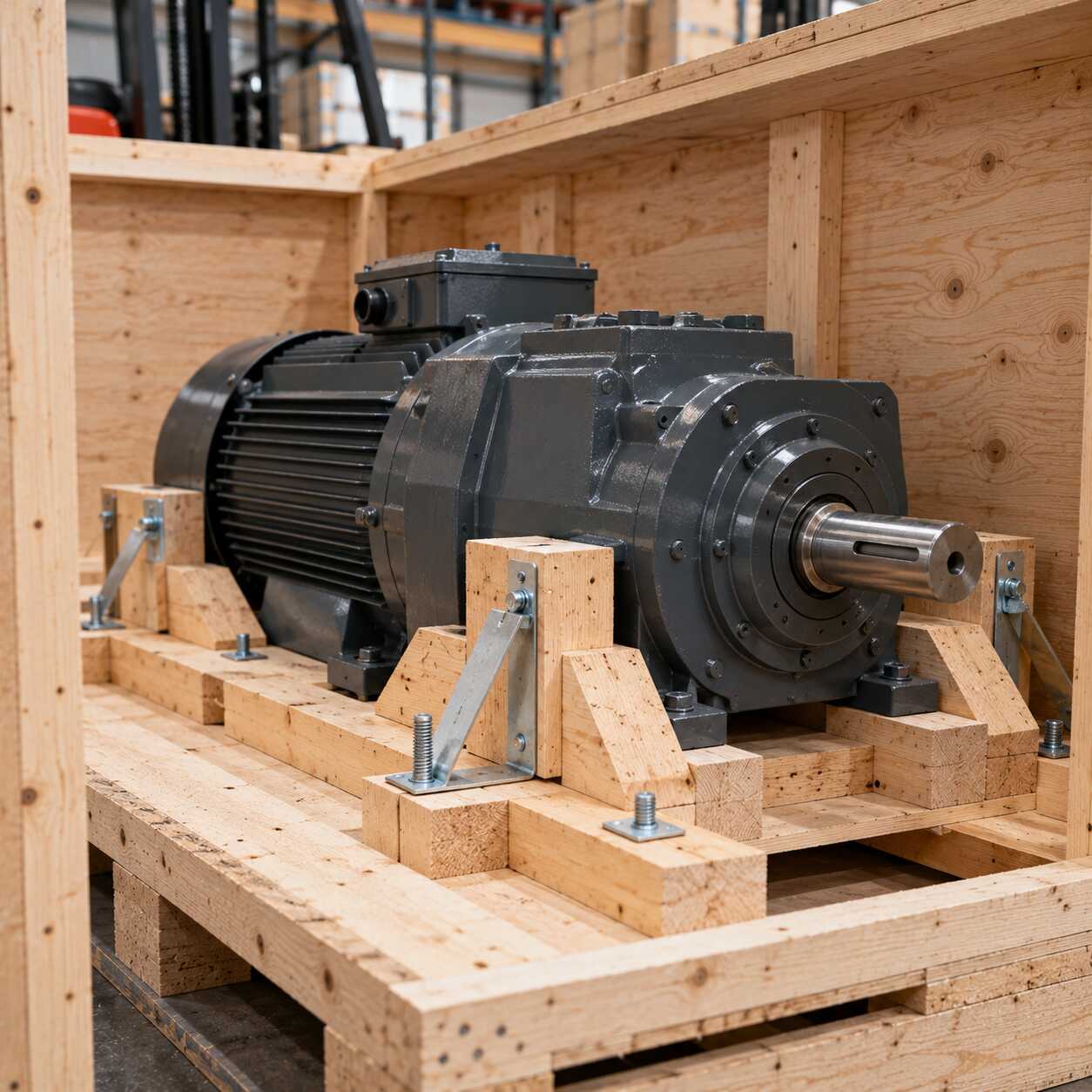
What Is Internal Bracing?
Internal bracing in a wooden crate is the system of supports and fasteners used to prevent a packaged product from shifting, tipping, or making uncontrolled contact with the crate during transport. It is an important part of packaging design, particularly when exporting industrial machinery, automotive parts, and heavy equipment. While the crate's outer structure protects against external conditions, the internal bracing system is intended to control movement within the package.
Select internal bracing methods according to the product's weight, geometry, center of gravity, and transport conditions. The same blocking, support, or fastening arrangement is not suitable for every product. The design should also account for the product's approved contact points.
Primary Purpose of Internal Bracing in a Wooden Crate
Sudden braking and turns during road transport, vessel movement at sea, and mechanical effects during loading can apply different forces to a product. Internal bracing is intended to limit the extent to which these forces cause uncontrolled movement.
Properly designed supports transfer loads to designated contact areas. However, simply surrounding a product with wooden blocks does not demonstrate that it is securely restrained. The attachment of blocks to the crate base and their contact with the product must also be assessed.
Common Internal Bracing Methods
Depending on the product, wooden export crates may use blocks, load-bearing cradles, mechanical fasteners, and suitable protective interface materials. Bolted connections may be considered at installation points approved by the manufacturer. Direct contact with hard wood may need to be avoided on sensitive surfaces.
Product removal and placement are also important when selecting a restraint solution. Safe removal of the equipment at its destination should be part of the internal layout plan.
Information to Check When Designing Internal Bracing
- Product weight: Verify net weight and load distribution.
- Center of gravity: Determine its position and how it affects tipping or sliding.
- Support points: Identify contact and fastening areas approved by the manufacturer.
- Transport method: Assess expected movement and handling conditions.
- Sensitive surfaces: Identify components requiring protection and suitable interface materials.
Bracing Plan for Custom Wooden Crates
For custom wooden crates, prepare the internal bracing plan together with the load-bearing structure of the crate base. Consider support locations, forces that may occur during forklift lifting, and the product's orientation inside the crate.
For corporate export operations, share product drawings, lifting points, and restraint requirements with the packaging manufacturer. After assembly, check that the connections are suitable and the product is correctly positioned in the crate. This allows the bracing design to be verified against the product's physical characteristics and planned shipping conditions.
Blocking and Support
Blocks and supports in a wooden crate are used to limit unwanted product movement during transport and transfer loads to designated points in the crate structure. For exports of machinery, motors, pumps, and industrial equipment in particular, the support arrangement should suit the product's geometry. As important components of an internal bracing system, blocks may not provide the expected protection if they are positioned incorrectly.
When planning supports, assess product weight, center of gravity, base construction, and sensitive areas. Blocks should do more than fill gaps; they must be secured to withstand forces that may occur during transport.
How Wooden Blocks Restrain Products
Wooden blocks can be used to limit product movement in specific directions. Suitable supports placed around machine feet help maintain the product's position on the crate base. Ensure that blocks do not press directly against sensitive surfaces.
Determine block dimensions and contact surfaces according to the product's geometry. Concentrating high forces over a small contact area can cause localized damage to the product or wooden components.
How Load-Bearing Supports Affect Load Distribution
In heavy-load wooden crates, support members can transfer product weight to the load-bearing base. Position these supports to align with the skids and cross members in the lower structure.
Concentrating the product's entire weight on a few small points can overstress base members. After technical assessment, larger support surfaces or load-bearing cradles suited to the product may be used.
Inspection Criteria for Blocks and Supports
- Placement: Position blocks according to the product's approved contact areas.
- Attachment security: Verify that supports are secured to the crate base using a suitable method.
- Load distribution: Assess localized stresses that may occur in load-bearing members.
- Surface protection: Use necessary protective interface materials in sensitive areas.
- Removal: Plan how to remove supports at the destination without damaging the product.
Support Plan for Custom Wooden Crates
Show the position of blocks and supports on the technical drawing for a custom wooden crate. For heavy machinery in particular, do not rely on friction alone; separately assess the risks of sliding and tipping.
For corporate export operations, the packaging manufacturer should obtain technical information from the machine manufacturer to identify safe support points. After assembly, inspect block attachments, support surfaces, and the product's position inside the crate. These recorded checks help ensure the industrial wooden crate is prepared for its transport conditions.
Sensitive Surface Protection
Protecting sensitive surfaces inside a wooden crate is an important packaging practice intended to prevent scratches, dents, abrasion, and impact damage to industrial products during transport and storage. Design the internal bracing system carefully for painted machine housings, precision-machined metal parts, electronic equipment, and coated surfaces. A strong wooden export crate does not mean that the product can safely be supported at every point inside it.
The protection plan should account for surface characteristics, approved contact points, and movement that may occur during transport. An unsuitable material or excessive restraint pressure can permanently deform a product's surface.
How Surface Damage Occurs Inside a Wooden Crate
Vibration during transport can cause repeated contact between the product and its supports. Hard wooden components resting directly against sensitive surfaces may increase abrasion risk, particularly for protective coatings.
Incorrectly positioned blocks, protruding fastener ends, and unsuitable support angles can also cause damage. Uncontrolled clearance inside the crate may allow the product to move and strike other packaging components.
Selecting Protective Interface Materials
Suitable protective interface materials can be placed between sensitive surfaces and load-bearing supports. Depending on technical requirements, consider foam, elastomer pads, protective textiles, or other surface separators.
Material selection should account not only for softness, but also for compression behavior, friction, chemical compatibility, and long-term contact. Some materials may mark painted surfaces or interact undesirably with protective coatings.
Checks for Sensitive Surface Protection
- Surface assessment: Identify areas sensitive to scratching, pressure, and friction.
- Contact points: Verify that supports are placed only in areas approved by the product manufacturer.
- Interface materials: Assess protective pads for compatibility with the load and surface.
- Fastener safety: Check that nails, screws, and other fasteners cannot contact the product.
- Movement control: Assess the risk of the product shifting away from its supports under transport vibration.
Surface Protection Plan for Custom Wooden Crates
Mark sensitive surfaces on technical drawings or photographs when designing a custom wooden crate. Include the thickness and placement of protective materials when dimensioning internal bracing components.
For corporate export operations, share technical information about surface sensitivities with the packaging manufacturer. Before closing the crate, inspect support contact points, protective material placement, and the possibility of product movement. This review helps protect sensitive equipment under the planned shipping conditions.
Center-of-Gravity Check
Checking the center of gravity is a key design step for keeping a product stable while it is lifted, loaded, and transported in a wooden crate. For exports of heavy machinery, engine assemblies, and industrial equipment in particular, carefully assess how the load is distributed inside the crate. A properly planned internal bracing system helps limit the risk of sliding, tilting, or tipping.
The center of gravity does not always coincide with the product's geometric center. In asymmetric machinery, the position of the motor, gearbox, or dense metal components can shift the weight distribution. This directly affects the placement of the load-bearing base and restraint components.
How the Center of Gravity Affects Wooden Crate Design
When designing a custom wooden crate, account for the product's center of gravity when positioning base skids and load-bearing cross members. Concentrated loads can overstress wooden components.
Use safe support areas when determining the product's position inside the crate. Shifting the product uncontrollably to balance its center of gravity can create new risks at lifting points.
Balance Checks for Forklift Lifting
For wooden export crates moved by forklift, assess gross weight, load-center distance, and fork placement together. A forklift's nominal capacity alone does not indicate its capacity at different load-center distances.
For crates with a high center of gravity, lifting height, direction of travel, and floor conditions are also important. Qualified personnel should perform lifting operations within the equipment's capacity limits.
Center-of-Gravity Checklist
- Product information: Verify net weight and center-of-gravity location.
- Support layout: Position load-bearing points according to load distribution.
- Internal bracing: Check the positions of blocks and mechanical fasteners.
- Forklift access: Assess fork placement and equipment capacity.
- Transport safety: Evaluate sliding and tipping risks for the shipping conditions.
Verifying the Technical Drawing and Restraint Plan
Show the center-of-gravity information provided by the machine manufacturer as clearly as possible on the crate's technical drawing. Changes to the product's shipping orientation may require the support and lifting plan to be reassessed.
For corporate export operations, the packaging manufacturer, product owner, and logistics team should work from the same technical data. After assembly, inspect support points and fasteners and record approvals. Verified center-of-gravity information helps ensure the wooden crate is prepared for safe transport.
Risk of Shifting During Transport
The risk of shifting inside a wooden crate is the possibility that a product will move away from its restraint points and change position, potentially damaging packaging components. Sudden braking, changes in direction, and loading movements can create horizontal forces, particularly during exports of heavy machinery, automotive parts, and industrial equipment. If the internal bracing system is not designed for these effects, product damage and post-shipment operational issues may result.
Shifting risk depends on more than the product's total weight. Base-surface characteristics, contact area, weight distribution, and transport method also affect movement. A product appearing stationary inside a wooden export crate does not, by itself, prove it will remain stationary during shipment.
How Transport Movement Affects Product Position
Braking and cornering during road transport can create forces that change the product's position inside the crate. At sea, vessel movement and cargo transfers can apply forces from different directions.
For machinery with a high center of gravity in particular, assess sliding risk together with the possibility of tipping. Supporting the product in only one direction may not sufficiently limit movement in other directions.
Using Blocks and Mechanical Restraints to Prevent Shifting
Wooden blocks can be used to limit product movement in designated directions. Their attachment to the crate base is as important as their placement; unsecured supports may shift during transport.
If the product has suitable fastening points, consider bolted restraints or other technically specified mechanical solutions. Assess friction-enhancing materials against the loading conditions rather than treating them as sufficient on their own.
Checks to Reduce Shifting Risk During Transport
- Base contact: Verify that product feet and support surfaces are suitable.
- Directions of movement: Assess the effects of forward, backward, and lateral forces.
- Block attachments: Check that supports are securely attached to the crate structure.
- Mechanical restraints: Verify that fasteners are applied only at product-approved points.
- Loading conditions: Account for forklift movements and the transport route.
Verifying Shifting Risk Before Shipment
For a custom wooden crate, plan the restraint layout together with the product's technical drawings and transport method. For critical applications, have the expected transport forces assessed by engineering; do not approve safe restraint based on visual inspection alone.
For corporate export operations, share restraint information among the product owner, packaging manufacturer, and logistics team. Inspect blocks, fasteners, and contact surfaces before closing the crate to help reduce product damage caused by shifting during transport.
Machinery and Spare Part Examples
Internal bracing for a wooden crate varies according to the physical characteristics of the machine or spare part being shipped. Equipment weight, geometry, sensitive surfaces, and fastening points are key criteria for selecting a suitable support system. Rather than applying one standard restraint layout to every product, assess each product technically when designing a custom wooden crate. This approach is intended to limit the risks of shifting, tipping, and contact damage during export transport.
Internal Bracing for Heavy Machinery and Engine Assemblies
For heavy equipment such as motors, generators, and pump assemblies, it is important to transfer the load safely to the crate base. Mounting feet and fastening points specified by the manufacturer provide the starting information for the restraint plan.
Where appropriate, bolted connections can be used together with load-bearing wooden supports. Before using the motor housing, pipe outlets, or sensitive connection surfaces as support points, verify their technical suitability.
Restraint Methods for Automotive Spare Parts
Gearbox housings, differential components, and metal castings may require custom supports because of their irregular geometry. Wooden blocks can be positioned to limit product movement. Use suitable protective interface materials on machined connection surfaces.
When several spare parts are placed in one export crate, prevent them from contacting one another. Assess the weight and support needs of each component separately, and stack parts only under verified transport conditions.
Protection and Positioning for Sensitive Equipment
Rigid wooden supports alone may not be sufficient for measuring instruments, control units, and sensitive mechanical components. Depending on the product's sensitivity to impact and vibration, consider suitable protective pads or engineered support systems.
Check how protective materials behave under pressure and whether they are compatible with the product surface. If heavy components share the same crate volume with sensitive equipment, plan separate restraint areas.
Inspection Points by Product Group
- Heavy machinery: Verify the center of gravity, mounting feet, and load-bearing base.
- Engine assemblies: Protect fastening points and sensitive protrusions.
- Automotive parts: Assess contact between parts and the risk of surface damage.
- Sensitive instruments: Check vibration and impact sensitivity and support-material suitability.
Creating a Product-Specific Restraint Plan
For machinery and spare-part packaging, share technical drawings, product weights, and lifting information with the packaging manufacturer. Identify restraint points, supports, and required protective materials before production.
Before closing the crate, inspect the product's positioning, joint integrity, and protection of sensitive areas. These practices help ensure that the wooden export crate is prepared for the transport requirements of the specific product group.
Restraint Plan Checklist
Using a standard checklist for internal bracing in wooden crates makes it easier to verify that a product is correctly positioned before shipment and that its restraint system is suitable. For exports of machinery, automotive spare parts, and industrial equipment in particular, prepare the restraint plan based on product weight, support points, transport method, and environmental conditions. Do not limit the inspection process to a visual check performed just before closing the crate.
Transferring restraint requirements to the technical drawings creates shared assessment criteria for production and quality teams. Verify critical connections against the forces that may occur during transport.
Technical Information Needed for a Restraint Plan
The inspection form should include the product's net weight, center of gravity, external dimensions, and approved fastening points. Also specify the product's transport orientation and whether a forklift or crane will be used.
For asymmetric machinery in particular, selecting restraint points based only on geometric dimensions is not appropriate. Assess the support arrangement together with the product manufacturer's technical restrictions.
Wooden Crate Internal Bracing Checklist
- Product information: Have weight, dimensions, and center of gravity been verified?
- Support points: Have contact areas approved by the manufacturer been identified?
- Block placement: Have wooden supports been secured in the planned positions?
- Mechanical fasteners: Have bolts, screws, and other fasteners been checked for suitability?
- Sensitive surfaces: Have protective interface materials been placed at the correct points?
- Movement control: Have risks of sliding, tipping, and rotation been assessed?
- Lifting safety: Are forklift entries compatible with the restraint layout and load-bearing base?
- Final approval: Have identified deficiencies been corrected and recorded?
Physical Inspection After Assembly
After completing the restraint system, check that the product is properly seated against its supports, connections are secure, and protective materials have not shifted. Correct any cracks, deformation, or fastening defects in wooden components.
For heavy and high-risk loads, visual inspection alone is insufficient. Use appropriate engineering calculations, fastener-capacity assessments, and performance testing where necessary.
Inspection Records and Shipment Approval
For corporate export operations, record the restraint inspection date, responsible personnel, and approved revision of the technical drawing. Photographing critical connections before closing the crate can support unpacking at the destination and any subsequent damage investigation.
Having the product owner, packaging manufacturer, and logistics team use the same restraint plan clarifies responsibilities. Linking completed inspections to the shipment file helps provide a traceable assessment of whether the wooden crate meets the product characteristics and planned transport conditions.