
 Türkçe
 English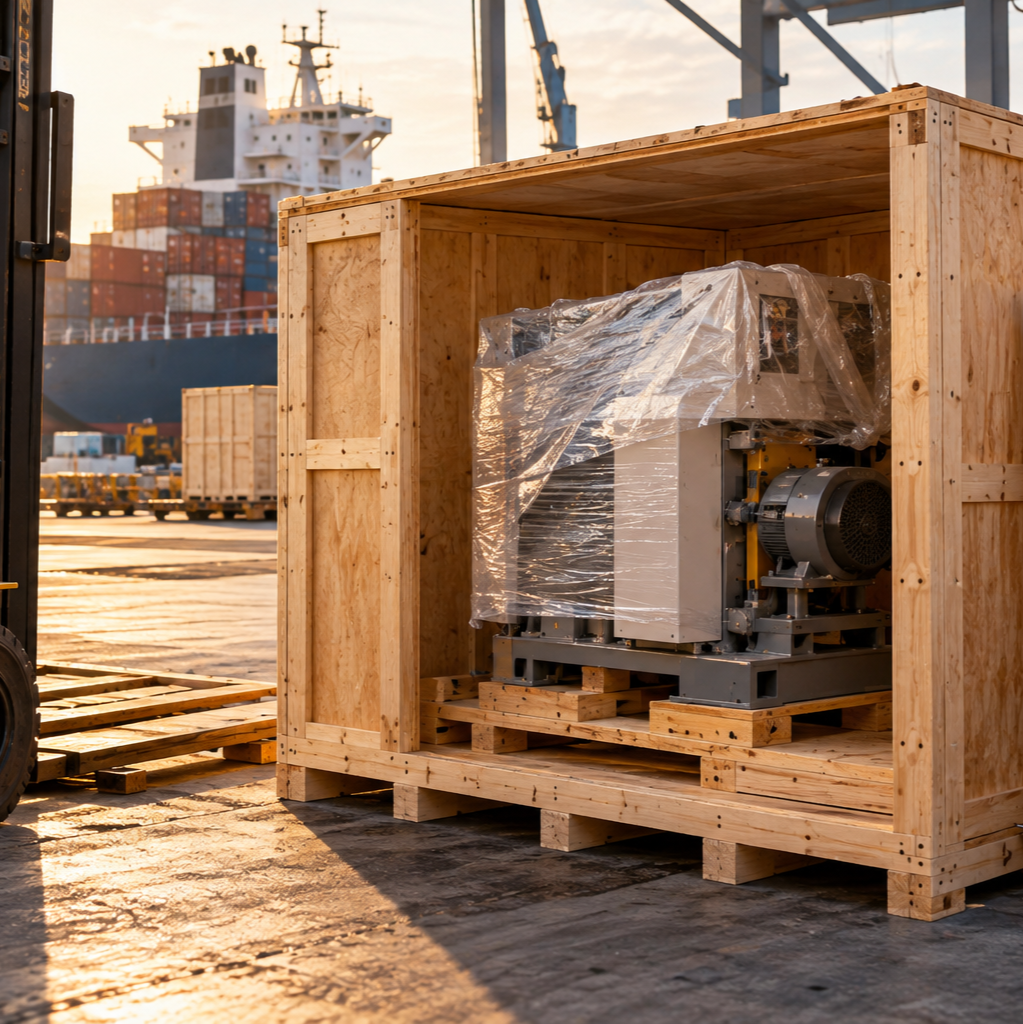
Machine Weight and Center of Gravity
Selecting a wooden export crate for machinery exports begins with a thorough assessment of the physical characteristics and operational requirements of the equipment being transported. Industrial machinery can vary significantly in terms of weight distribution, geometric structure, sensitive components, and transportation conditions. Therefore, designing an export crate based solely on the external dimensions of the machine is not sufficient. The total weight of the machine, the location of its center of gravity, and its contact with load-bearing surfaces are among the fundamental criteria for safe packaging design.
Particularly in international shipments of heavy industrial machinery, production line equipment, and industrial systems, the load-bearing structure of the wooden export crate must be planned according to the characteristics of the cargo. When the center of gravity is not properly evaluated, instability may occur during loading, lifting, and transportation. This can negatively affect both the protection of the machinery and the safety of logistics operations.
Impact of Total Weight on Crate Design
When designing a wooden export crate, the total weight of the machine in its shipping-ready condition must first be determined. Auxiliary equipment attached to the machine, components that will remain assembled during transportation, and other items placed inside the packaging should be included in this assessment. Based on the information obtained, an appropriate design approach can be developed for the crate base, load-bearing supports, and connection points.
How the machine's total weight is transferred to the crate base is just as important as the overall weight itself. Loads concentrated at specific points can create varying levels of stress on the supporting structure. Therefore, the machine's support points and the areas in contact with the crate base should be examined in advance.
Role of the Center of Gravity in Transportation Safety
The center of gravity is the reference point at which the mass of a machine is considered to be balanced. Its position affects how the load behaves, particularly during forklift lifting, crane operations, and container loading. It is important to recognize that the geometric center of a machine does not necessarily coincide with its center of gravity.
In machines with asymmetrical structures, weight concentrated on one side can increase the risk of tipping or shifting during lifting and transportation. Therefore, the machine's balance, securing points, and the positions from which handling equipment will support the load must be evaluated together when designing a wooden export crate.
Selecting the right wooden export crate for machinery exports depends not only on the physical strength of the packaging but also on the compatibility between the machine and its supporting structure. Evaluating technical specifications before production helps enhance product protection while contributing to more predictable and efficient management of loading and shipping operations.
Protection of Sensitive Surfaces
When designing wooden export crates for machinery exports, the objective should be not only to protect equipment against external impacts but also to preserve the condition of its sensitive surfaces throughout transportation. Industrial machinery may include machined surfaces, connection areas, moving mechanisms, control panels, and protruding components, each requiring different levels of protection. Therefore, rather than applying the same protective method to every surface, potential contact points and areas vulnerable to damage should be evaluated individually during the packaging process.
Particularly in long-distance international transportation, vibrations and shocks occurring during loading and unloading operations can have undesirable effects on sensitive components. Measures that restrict movement inside the wooden crate and prevent direct contact with critical surfaces are essential elements of shipping safety. When determining appropriate protective solutions, surface characteristics, machine structure, and transportation conditions should be evaluated together.
Identifying Sensitive Machine Components
Identifying the areas of a machine that require protection before designing the packaging helps establish an appropriate internal support system. Components with sensitive surfaces, protruding equipment, and parts that may move during transportation should be included in the technical assessment.
- Machined surfaces: Suitable protective separators should be considered for areas vulnerable to scratches, friction, and damage caused by direct contact.
- Control and connection components: Control panels, connection terminals, and protruding parts should be protected against potential contact during transportation.
- Moving mechanisms: Components that should not move freely during shipment must be secured according to the manufacturer's instructions.
- Precision measurement and adjustment areas: Points that may affect the machine's operational accuracy should be protected against load transfer and unwanted pressure inside the packaging.
Preventing Contact and Friction Risks Inside Wooden Crates
The primary approach to protecting sensitive surfaces is to secure the machine in a controlled position inside the wooden crate. Protective spacers, suitable supports, and surface-compatible separating materials can help reduce the risk of direct contact. However, the protective materials themselves must not leave marks on the surfaces or cause undesirable chemical interactions.
An internal securing system that relies solely on the machine's outer housing may not be suitable for every type of equipment. Therefore, securing and support points should be determined according to the handling and transportation areas approved by the manufacturer. This approach helps prevent protective components from transferring additional loads to sensitive surfaces.
Choosing a fully enclosed wooden export crate can provide additional protection against direct contact and contamination from the external environment. However, an enclosed design alone should not be considered sufficient. Risks associated with condensation, surface friction, and movement inside the crate must also be evaluated separately.
Pre-Shipment Surface Protection Inspection
Before completing the packaging process, the protection of sensitive areas, the positioning of securing elements, and the suitability of protective materials should be inspected. It is important to ensure that the protective system is arranged to prevent displacement during loading and avoid applying pressure to critical machine components.
Protecting sensitive surfaces during machinery exports is not merely a supplementary aspect of wooden export crate design but a fundamental requirement that directly affects product safety. By combining product-specific protective measures, appropriate internal securing methods, and pre-shipment inspections, the risk of transportation-related surface damage can be reduced.
Vibration and Impact Risks
Vibration and impact risks are among the key operational factors that must be considered when designing wooden export crates for machinery exports. During international shipments, machinery may be exposed to various mechanical forces throughout road transportation, port operations, container loading, and sea freight transfers. Failure to manage these forces properly can result in damage to the machine's exterior structure or negatively affect the functionality of its sensitive components.
In addition to providing a protective barrier between the machine and the external environment, a wooden export crate should help manage the forces generated during transportation in a controlled manner. However, a durable wooden crate does not necessarily mean that the machinery inside is adequately protected against all vibrations and impacts. Effective protection requires a comprehensive assessment of the crate construction, internal support points, securing methods, and the machine's sensitivity characteristics.
Sources of Vibration During International Shipping
Vibration refers to the transmission of repetitive mechanical movements to the machine and its packaging system during transportation. These movements become particularly significant in long-distance logistics operations. Vehicle movement, road conditions, cargo behavior inside containers, and cargo handling procedures can generate different vibration patterns.
If the machine is not adequately secured inside the wooden crate, repetitive movements may place stress on connection points or cause unwanted movement of sensitive components. Therefore, reducing vibration risks is directly related not only to the selection of crate materials but also to the positioning and securing of the machine within the packaging.
Protective Packaging Design Against Impact Risks
Impacts can occur when sudden mechanical forces arise during loading, unloading, or transportation. Forklift operations, transfers between handling equipment, and uncontrolled cargo movement are among the primary situations that make impact risk assessment necessary.
When planning impact protection for a wooden export crate, the strength of the external structure and the protective arrangement surrounding the machine must be considered together. It is particularly important to prevent sensitive areas from coming into direct contact with the crate walls and to establish suitable supports that prevent the machine from shifting during shipment.
- Crate construction: A load-bearing structure designed for transportation conditions helps manage external mechanical forces.
- Internal securing systems: These systems limit uncontrolled movement of the machine inside the crate.
- Protective spacers and supports: These components reduce the risk of damage to sensitive parts caused by direct contact and friction.
- Load distribution: Transferring the machine's weight to appropriate support points helps prevent excessive stress from developing in specific areas.
- Operational control: Planning lifting, loading, and securing procedures in advance supports effective management of transportation-related risks.
Importance of Internal Securing in Vibration and Impact Protection
Internal securing methods that restrict machine movement inside the crate are essential components of vibration and impact management. However, incorrectly positioned securing points can cause transportation forces to be transferred to sensitive surfaces or machine components that are not designed to withstand such loads.
Therefore, the manufacturer's instructions, machine weight distribution, and transportation characteristics should be considered when determining support and connection points. For vibration-sensitive equipment, technically evaluated shock-absorbing or vibration-isolation solutions may be used. These solutions should be selected according to the machine's specific characteristics and designed to work in conjunction with the securing system.
Managing vibration and impact risks in machinery exports is important not only for product safety but also for maintaining the continuity of logistics operations. By combining appropriate wooden export crate design, effective securing methods, and pre-shipment technical assessments, the risk of mechanical damage during transportation can be significantly reduced.
Base Support Design
The base support design of a wooden export crate plays a critical role in machinery exports by ensuring that equipment is safely supported, lifted, and maintained in a stable position throughout transportation. The base support system serves as the primary structural framework that carries the machine's weight and transfers the forces generated during transportation to the packaging structure. Therefore, when manufacturing wooden export crates, the base support structure must be designed not only according to external dimensions but also based on the machine's weight distribution, support points, and logistics operation requirements.
Since industrial machines vary in their physical characteristics, using the same base construction for every shipment may not be appropriate. A machine-specific assessment of the base support system is particularly important for heavy, asymmetrical equipment or machinery containing sensitive components. A properly designed supporting base contributes to more controlled loading and unloading operations while helping maintain the structural integrity of the packaging.
Load-Bearing Structure Suitable for Machine Weight
When designing the base support system, the machine's total weight and the areas where this weight is concentrated should first be evaluated. Load transfer between the machine feet, connection points, and base surface plays a decisive role in planning the supporting structure. If the load is concentrated at specific points, additional structural support may be required in these areas.
The arrangement of load-bearing elements in the wooden export crate base should correspond to the machine's support points. Rather than focusing solely on total weight, it is also necessary to examine how the load is distributed during lifting and transportation. This approach helps reduce localized stress and unwanted deformation in the base structure.
Compatibility with Forklifts and Lifting Equipment
One of the primary functions of the base support system in machinery exports is to facilitate the safe handling of packaged equipment using appropriate transportation equipment. The positioning of forklift entry points, the structure of the supporting base, and load stability during lifting must be evaluated together. Ensuring that forklift forks can access the supporting structure at suitable points contributes to well-planned loading and unloading operations.
Designing forklift entry points solely to provide physical access is not sufficient. The load must also remain balanced during lifting, and the supporting elements must be adequately reinforced. For operations involving cranes or other lifting equipment, the lifting method, attachment points, and load transfer requirements should be assessed separately.
Securing and Support Points in Base Support Systems
Proper positioning of the machine on the supporting base is essential for limiting movement inside the wooden crate. Securing methods should be based on the attachment areas approved by the machine manufacturer. This helps reduce the risk of transportation forces being transferred to sensitive components or unsuitable surfaces.
- Identification of support points: Areas that carry the machine's weight should be identified, and the base structure should be designed accordingly.
- Assessment of weight distribution: Load concentrations in specific areas should be considered to ensure balanced performance of the supporting structure.
- Planning forklift entry points: Accessibility for handling equipment, lifting direction, and conditions within the operational area should be evaluated.
- Machine securing points: Fastening components should be positioned according to the machine's structural characteristics and the manufacturer's instructions.
- Shipping conditions: Different loading forces that may occur during road transportation, sea freight, and cargo transfer operations should be incorporated into the design process.
Operational Efficiency in Base Support Design
Base support design is not merely a technical measure intended to protect machinery. It is also an important part of the logistics process, extending from packaging operations at the manufacturing facility to unloading procedures at the final destination. Base systems designed according to product specifications and compatible with handling equipment can help reduce the need for additional interventions during operations.
When designing custom-sized wooden export crates, it is important to evaluate machine positioning, securing methods, and lifting requirements before production. Particularly for large-scale equipment, integrating the base support design with an on-site packaging plan allows access limitations and assembly conditions at the operational site to be identified in advance.
In conclusion, base support design is one of the fundamental elements of safe packaging in machinery exports. A wooden crate base designed according to the machine's weight, center of gravity, support points, and transportation method helps ensure product safety and supports the controlled execution of logistics operations.
ISPM 15 Compliant Production
When selecting wooden export crates for machinery exports, compliance with international phytosanitary requirements is an important aspect of shipment planning. Export crates manufactured using solid wood materials may be subject to regulations designed to prevent the spread of harmful organisms between countries through international trade. In this context, ISPM 15 is an international phytosanitary standard that regulates the appropriate treatment and marking of wood packaging materials.
For businesses involved in machinery exports, ISPM 15 compliant production extends beyond simply preparing packaging materials. The suitability of wooden components, heat treatment procedures, IPPC marking, and verification of relevant records should be evaluated together. This approach helps reduce the risk of border inspection issues related to wood packaging while contributing to more efficient and structured export operations.
Importance of the ISPM 15 Standard in Machinery Exports
The ISPM 15 standard aims to reduce the risk of wood packaging materials used in international transportation facilitating the spread of harmful organisms. Wooden crates, pallets, and load-supporting elements used for shipping industrial machinery may fall within the scope of this standard depending on their material characteristics.
It is important to review the wood packaging requirements of the destination country before shipment. Non-compliant packaging materials may result in additional inspections, treatment requirements, packaging replacement, or shipment rejection during official inspections at the destination. Such situations can negatively affect logistics planning and delivery schedules.
Machine manufacturers and businesses managing export operations should communicate the destination country and applicable packaging requirements to their suppliers when ordering wooden export crates. This facilitates the planning of necessary inspections during production and the selection of an appropriate packaging solution.
Heat-Treated Export Crate Production Process
Heat treatment is a process designed to reduce the risk of harmful organisms by heating wood packaging materials under controlled and specified treatment conditions. As one of the approved treatment methods under ISPM 15, this process must be carried out using appropriate equipment and in accordance with applicable regulations.
In the production of heat-treated export crates, proper preparation of wooden components, monitoring of the treatment process, and compliance with subsequent marking requirements are essential. Simply drying wood materials or storing them for a certain period does not, by itself, demonstrate that the treatment required under ISPM 15 has been performed.
During production and packaging planning, care must be taken to ensure that heat-treated components are not replaced with non-compliant wood materials. In particular, wooden blocks, support pieces, and load-securing elements added later to secure machinery should be assessed separately to determine whether they fall within the scope of the standard.
IPPC Marking and Wood Packaging Traceability
The IPPC mark is a standardized marking system established under the International Plant Protection Convention, indicating that wood packaging has undergone treatment in accordance with applicable phytosanitary requirements. Proper marking allows wooden export crates to be identified during official inspections and linked to the treatment applied.
Correct application of the IPPC mark is an important control point in export packaging preparation. The legibility of the mark, its placement on appropriate surfaces, and its consistency with relevant production records should be verified. In Türkiye, additional traceability and recordkeeping requirements under current national regulations must also be taken into consideration.
Pre-Shipment ISPM 15 Compliance Inspections
In machinery exports, assessing packaging compliance only during production is not sufficient. Before shipment, the overall condition of the wooden export crate, its markings, and the necessary records should be inspected. This process helps identify potential packaging deficiencies before loading is completed.
- Material compliance: Assessing the components used in the wooden export crate to determine whether they fall within the scope of the standard.
- Heat treatment verification: Confirming through relevant records that wood materials covered by the standard have undergone the required treatment.
- IPPC marking: Checking the compliance, legibility, and placement of markings on the required surfaces.
- Additional support elements: Inspecting the compliance of wooden blocks and securing components used during shipment preparation.
- Traceability: Reviewing treatment records and relevant documentation required under applicable regulations.
- Destination country requirements: Verifying the current phytosanitary and wood packaging requirements of the importing country.
An ISPM 15 compliant production approach supports the preparation of wooden packaging for machinery exports in accordance with international requirements. However, it is important to remember that the primary purpose of the standard is to reduce phytosanitary risks. The structural design of the packaging and its internal securing system must be evaluated separately to protect machinery against impacts, vibrations, and forces generated during loading and transportation.
In conclusion, selecting heat-treated export crates is an important part of packaging compliance and operational risk management in international machinery shipments. Proper material selection, compliant treatment procedures, IPPC marking inspections, and pre-shipment verification measures contribute to more controlled and reliable export operations.
Container Loading Plan
In machinery exports, container loading planning is one of the key stages of the operational process, extending from the dimensioning of wooden export crates to shipment safety. Ensuring that packaging systems used for the international transportation of industrial machinery are compatible with container specifications supports controlled loading and unloading operations. Therefore, when designing a wooden export crate, it is necessary to evaluate not only the physical dimensions of the machine but also the accessibility conditions of the container, cargo positioning, and securing requirements.
Particularly when shipping large or heavy machinery, load distribution and packaging positioning inside the container can be decisive factors in operational safety. A properly prepared loading plan contributes to more efficient use of available transportation space while helping reduce risks associated with uncontrolled cargo movement. Compatibility between the wooden export crate and the container should be technically assessed before packaging production is completed.
Wooden Export Crate Design Based on Container Specifications
The first step in container loading planning is to determine the external dimensions of the machine in its fully packaged condition. The outer dimensions of the wooden crate, its cover structure, base support system, and any protruding fastening elements should be evaluated together. This information enables an accurate assessment of the usable space inside the container and the applicable loading conditions.
Having sufficient internal container volume does not necessarily mean that the machine can be loaded without difficulty. The container door opening, maneuvering space required for loading equipment, and the direction in which the packaging enters the container must also be considered. Particularly when preparing custom-sized wooden crates for machinery exports, evaluating these details in advance can help minimize unexpected compatibility issues during loading.
Load Distribution and Stability Inside the Container
Positioning heavy machinery inside a container should not be based solely on the availability of empty space. The machine's center of gravity, the supporting base of the wooden export crate, and the way the load is transferred to the container floor must be examined together. Improper positioning may lead to excessive load concentration in certain areas or undesirable changes in stability during transportation.
When planning load distribution, the structural characteristics of the container, its load capacity, and the loading criteria established by the logistics service provider should be considered. In operations where multiple wooden crates or palletized loads are transported within the same container, interactions between individual cargo units must also be evaluated. The position of each packaging unit, overall load balance, and available securing options should be planned together.
Securing Cargo and Preventing Shifting Inside the Container
During international sea freight transportation, cargo inside containers may be exposed to various mechanical forces caused by transportation movements. Therefore, properly securing the wooden export crate inside the container is essential. Securing the machine inside the crate alone does not eliminate the risk of the crate moving within the container.
In cargo securing planning, the connections between the machine and the wooden crate, as well as the securing of the wooden crate inside the container, should be treated as separate safety measures. Appropriate securing methods should be determined by considering the structural characteristics of the packaging and the suitable anchoring points available inside the container.
- Crate positioning: Placing the wooden export crate inside the container in accordance with loading and transportation requirements.
- Center of gravity assessment: Evaluating the combined weight distribution of the machine and its packaging.
- Shifting risk management: Determining appropriate securing solutions to prevent uncontrolled cargo movement during transportation.
- Assessment of securing points: Ensuring that securing forces are transferred to appropriate load-bearing areas.
- Loading equipment compatibility: Planning safe access and maneuvering conditions for forklifts or other cargo handling equipment.
- Final inspection: Examining cargo positioning, packaging integrity, and securing arrangements before the container is closed.
Impact of Wooden Crate Dimensions on Logistics Efficiency
Designing wooden export crates larger than necessary can reduce the usable space inside containers during machinery shipments. However, reducing protective clearances and securing areas solely to save space is not an appropriate approach. When determining packaging dimensions, the objective should be to achieve a balanced design that considers product safety, operational accessibility, and efficient utilization of transportation space.
Custom-sized wooden crate solutions allow packaging to be designed according to the physical characteristics of machinery for which standard packaging is unsuitable. This approach can help reduce unnecessary empty spaces and support more controlled container loading arrangements. However, every dimensional design decision must be evaluated while maintaining the necessary protective supports and adequate space for safe securing.
Technical Assessment Before Container Loading
When preparing a container loading plan for machinery exports, the external dimensions, total weight, center of gravity, lifting points, and securing requirements of the packaged equipment should be evaluated together. The loading plan, prepared according to container operating conditions and transportation arrangements, should be aligned with the design process of the wooden export crate.
In conclusion, container loading planning is an important logistics requirement that directly influences wooden packaging design in machinery exports. Appropriate dimensioning, balanced load distribution, controlled securing, and pre-shipment assessment processes strengthen the compatibility of wooden export crates with transportation operations. This enables the development of a shipping approach that prioritizes product safety while supporting efficient utilization of logistics resources.
Machinery Shipping Checklist
The pre-shipment inspection process in machinery exports is an important stage that supports the safe and well-organized execution of logistics operations from the manufacturing facility to the final destination. Designing wooden export crates according to machine specifications, completing protective packaging procedures, and evaluating international transportation requirements form the foundation of shipment preparation. However, selecting the appropriate packaging does not eliminate the need for technical and operational inspections before loading.
Particularly when exporting heavy and sensitive industrial machinery, the structural integrity of the packaging, machine securing arrangements, suitability of lifting points, and consistency of shipping documentation should be examined together. Using a systematic checklist helps identify potential deficiencies in advance and facilitates coordination between relevant teams. This enables production, quality control, procurement, and logistics departments to conduct a coordinated pre-shipment assessment.
Pre-Shipment Inspection Steps for Machinery Exports
Shipment inspection should be approached as an integrated process that begins with the machine's technical specifications and continues through the final assessment of its packaging condition. Inspection activities should not be limited to visual examinations; relevant technical documentation and operational information must also be reviewed.
- Machine dimensions and weight specifications: The physical characteristics of the machine prepared for shipment should be compared with the information used in designing the wooden export crate. Any components added or removed after the initial assessment should be evaluated to determine whether they affect packaging suitability.
- Wooden crate construction: The crate base, load-bearing supports, fastening elements, and external protective structure should be inspected. The packaging should be checked for visible damage or nonconformities that could compromise transportation safety after production.
- Internal securing arrangements: The positioning of the machine inside the crate and the suitability of its securing points should be examined. Connections should be designed to prevent damage to sensitive components while restricting uncontrolled machine movement.
- Protection of sensitive surfaces: It should be verified that machined surfaces, control components, and protruding parts are adequately protected using appropriate protective materials and methods. The possibility of protective materials shifting during transportation should also be evaluated.
- ISPM 15 and IPPC compliance checks: Relevant wood packaging materials should be inspected for compliance with applicable phytosanitary requirements. The legibility of required markings and the suitability of associated treatment records should also be verified.
- Lifting and loading preparation: Forklift entry points, the supporting base, and the intended lifting method should be assessed for compatibility with the machine and its packaging system. Necessary loading and handling information should be communicated to the teams responsible for the operation.
- Container positioning and cargo securing: The position of the wooden export crate inside the container, weight distribution, and cargo securing arrangements should be inspected. The feasibility of the securing plan developed to minimize movement inside the container should be verified.
Inspection of Packaging Integrity and Operational Records
Final inspections conducted after wooden export crate production help determine whether the packaging is ready for shipment. Particular attention should be given to the overall condition of crate connections, the integrity of load-bearing components, and the machine's securing system. Addressing any nonconformities identified during inspection before loading helps reduce operational risks.
Maintaining organized photographic records and relevant inspection documentation during shipment preparation is also beneficial. Documenting the internal arrangement before the crate is closed and its external condition after packaging is completed facilitates technical assessments when necessary. These records can serve as supporting documentation for corporate quality management and shipment tracking processes.
Interdepartmental Coordination in Export Operations
Safe machinery shipment cannot be considered the sole responsibility of the packaging manufacturer or logistics service provider. Machine manufacturers, packaging suppliers, export operations teams, and transportation coordinators must collaborate using accurate technical information. Complete information sharing is particularly important regarding the machine's center of gravity, lifting requirements, and special protection needs.
Clearly defining responsibilities before shipment helps prevent duplicated inspection activities and reduces the risk of overlooking critical steps. Packaging compliance and container cargo securing should be treated as separate areas of assessment, with the necessary inspections completed by the relevant qualified teams.
In conclusion, selecting wooden export crates for machinery exports requires a comprehensive evaluation of multiple factors, ranging from machine weight and sensitivity to international packaging requirements. Product-specific crate design, controlled internal securing, proper loading planning, and systematic pre-shipment inspections contribute to safe and efficient export operations. During the technical assessment and quotation process for wooden export crates, the machine's dimensions, weight, technical drawings, and shipping conditions should be provided.