
 Türkçe
 English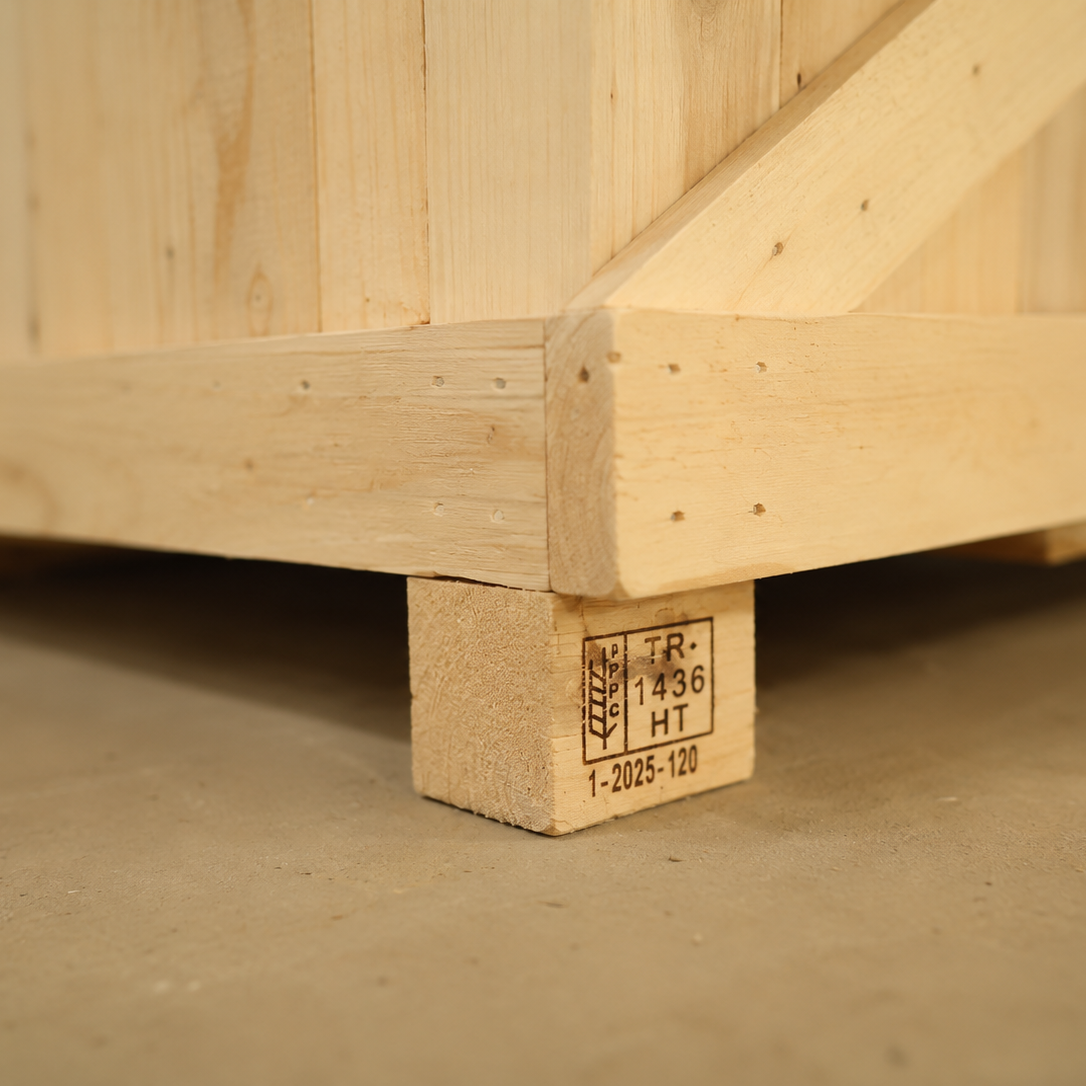
Reducing Quarantine Risk
Using heat-treated export crates is a key measure for reducing the likelihood that pests will be transported between countries in solid-wood packaging. Raw wood may carry insects, larvae, and other organisms beneath bark, inside cracks, or within its structure. Because crates, pallets, open-frame cases, skids, and restraint blocks travel through many countries and logistics hubs, the risk extends beyond one shipment. Heat treatment and IPPC marking in accordance with ISPM 15 support a controllable phytosanitary packaging system.
Quarantine risk may arise from packaging even when the product itself is unrelated to plants. Metal machinery, electrical panels, automotive parts, and industrial equipment may be accompanied by solid-wood crates that are inspected at the border. Exporters must therefore assess base skids, cross-members, side uprights, and internal blocks in addition to the commercial product. A heat-treated export crate provides a controlled starting point for preventing packaging-related quarantine noncompliance.
Under conventional ISPM 15 heat treatment, the entire solid-wood profile, including its core, must reach at least 56°C and remain at that level continuously for at least 30 minutes. Heating only the kiln air or timber surface is insufficient. Thick skids and structural sections heat more slowly, so treatment must be verified at the slowest-heating point. Applying HT without appropriate temperature monitoring and records does not provide reliable control.
A visible and legible IPPC mark helps inspectors recognize treated wood. It should include the IPPC symbol, TR country code for Türkiye, authorized facility number, and HT treatment code. Faint, incomplete, or covered marks impede verification. Marks on two opposite vertical faces improve the chance that one remains visible in a container. The mark is not decoration or a substitute for treatment; it is a traceability element identifying the authorized treatment and production chain.
Mixing treated timber with untreated material during production can reintroduce quarantine risk. One unknown block, cross-member, or support added after completion can cause the entire package to be questioned. Store treated timber separately, track cut components by production group, and inspect every solid-wood element used in assembly. Never add random wood during field packing, even for small restraint pieces.
Do not reuse pallets and crates solely because they carry an old IPPC mark. Previous shipments may have damaged them or introduced repairs and unmarked reinforcements. Different facility codes can create uncertainty about source and repair history. Before reuse, inspect both structural condition and marking integrity. Low-cost, unverifiable packaging can lead to border delays, repacking, return, or separation costs.
One mark check cannot manage quarantine risk by itself. Consider current destination-country practices, transit points, customer requirements, and all additional wood used in the shipment. Container dunnage can create a separate risk even when the main crate is compliant. The exporter, crate producer, logistics provider, and loading crew must apply the same material rules.
Integrated Quarantine-Risk Control
Assess heat treatment across the crate base, uprights, cross-members, internal blocks, and other solid wood used during loading. The IPPC mark, treatment record, and physical package must correspond to the same production group.
When ordering, provide destination, route, dimensions, weight, and field-support requirements. On completion, verify TR, facility number, HT, and post-loading visibility. Linking the treatment record to the crate order and using only eligible timber on site makes risk manageable from production through container loading, reducing delays and repacking.
Compliance in Customs Procedures
Heat-treated export crates reduce packaging-related uncertainty in customs by supporting compliance of solid-wood packaging with international phytosanitary rules. Even where the product is metal, plastic, electronic, or industrial machinery, crates, pallets, skids, and blocks may be inspected separately. ISPM 15 treatment and IPPC marking provide standardized information about packaging source and treatment, helping authorities in different countries recognize it efficiently.
Customs compliance requires more than an IPPC symbol. The mark must include a readable, permanent country code, authorized facility number, and HT code in the standard arrangement. Faint codes, unreadable facility numbers, or marks hidden by film may trigger additional inspection. Marks on two opposite vertical faces support visibility after loading.
Review current destination acceptance conditions before design. ISPM 15 provides an international basis, but inspection intensity and product-specific requirements may vary. Include transit ports and transfer hubs. Early information exchange among exporter, customs representative, carrier, and consignee is valuable; a late destination change may require reassessment of marks, materials, and shipment records.
Processed exterior panels do not eliminate solid wood in base skids, cross-members, uprights, or restraints. Heavy-duty base elements may represent most of the solid-wood volume. Select container dunnage with equal care. Unknown solid wood added during load securing can create risk despite a compliant main crate.
Traceability is strengthened when treatment records, order details, invoice scope, and the facility code are linkable. The physical mark does not replace commercial invoices or transport documents. Packing lists showing crate numbers, dimensions, and net and gross weights help match packages to products. Wording on a document cannot validate an incorrect physical mark.
Used or repaired packaging needs careful review. An old mark does not prove that every current component belongs to the same treatment group. Unmarked repair skids or blocks and mixed country or facility codes create uncertainty. Check structural strength, marking integrity, and every later solid-wood addition.
Packaging noncompliance at customs can cause holding, extra inspection, or replacement. Depending on destination rules, transfer to a new crate may generate port labor, packaging, storage, vehicle waiting, and delivery-delay costs. For schedule-sensitive machinery, even a short delay can affect installation. Proper treatment and marking manage these risks during production.
Core Customs-Compliance Control Chain
Verify destination conditions, eligibility of solid-wood components, IPPC mark, facility code, HT code, and order records together. Include additional wood used inside the container.
Before loading, inspect all faces for legibility, code consistency, and unobstructed marks. Match crate number, gross weight, dimensions, and contents with shipment records, and confirm the source of field-added supports. Recheck requirements after any destination or route change. Verifiable production data turns customs compliance into a controlled process rather than a theoretical stamp.
Improving Product Safety
Combined with correct structural design and internal restraint, a heat-treated export crate supports controlled product protection throughout international shipment. Its purpose is not only enclosure: it transfers weight to the base, limits movement, and creates a physical barrier. Road vibration, braking, port handling, container movement, and warehouse transfers impose forces from different directions. A crate designed for actual dimensions and weight helps prevent these forces from reaching sensitive surfaces directly.
The base is the primary load-bearing section. Foot positions, chassis dimensions, center of gravity, and point loads must be known; external dimensions alone are insufficient. Main skids and cross-members should transfer load evenly to forklift forks and the vehicle floor, with extra reinforcement beneath offset heavy components. Heat treatment supports phytosanitary compliance, while capacity still depends on timber sections, connections, and load distribution.
Internal restraints limit forward, rearward, sideways, and upward movement. Blocks, bolts, metal straps, diagonal braces, and dedicated fixtures may be combined for the product geometry. Avoid pressure on thin covers, displays, control panels, and delicate pipes; use chassis or durable body points. Connect restraints to strong base zones, and plan a safe removal sequence at destination.
Closed crates isolate surfaces from contact, dust, particles, and uncontrolled access; open-frame cases can provide visibility and use fewer panels for robust products. Select on sensitivity, route, outdoor waiting, and inspection requirements—not price alone. A closed crate is not automatically waterproof. Rain, maritime humidity, and long exposure may require covers, barrier film, desiccants, or corrosion protection.
Foam, felt, rubber pads, and elastomer blocks can manage shock and vibration, but soft filler does not replace structural restraint. Select density, thickness, and compression behavior for the product. Overly hard supports transmit vibration; overly soft materials may collapse. Plan cushioning and structural securing as distinct, complementary functions.
Forklift and crane operations are critical damage points. Channels must suit fork thickness, length, and direction. Standard forks may not reach the center of gravity of a long crate. For crane lifting, assess sling contact, angles, and upper-structure strength. Clearly mark lifting directions, center of gravity, and gross weight; markings support, but do not replace, sound engineering.
Provide dedicated areas for spares, cables, installation fixtures, and small components. Loose items can damage surfaces or become lost. Secure heavy accessories low without destabilizing the crate and group small items in enclosed compartments. Include their dimensions and weights from the start and link the accessory list to the crate number.
Integrated Product Protection
Combine eligible heat-treated timber with a weight-rated base, controlled internal restraint, correct lifting points, and product-specific moisture or impact protection.
Provide net dimensions, weight, foot layout, center of gravity, sensitive surfaces, and lifting method when ordering. Route, container, outdoor waiting, and destination unloading also influence protection. Before shipment, inspect restraint, forklift entries, panel connections, IPPC marks, and external dimensions. Managing heat treatment, mechanical strength, and environmental protection together supports safer delivery.
Insect, Larva, and Fungal Risks
Without proper control, solid-wood packaging can transport insects, larvae, and other pests between countries. Export crates, pallets, open-frame cases, skids, and blocks travel long routes, making this an international phytosanitary concern. Organisms from the tree’s origin may remain in bark, cracks, or internal tissue and spread to local plant life after arrival. ISPM 15 measures focus on reducing this transport risk.
Adult insects may be visible, but larvae can remain inside the wood, so appearance alone is insufficient. Small holes, powder-like residue, bark, or irregular channels may indicate activity, yet absence of visible signs does not prove zero risk. Thick skids are difficult to inspect internally. Use eligible sources, bark control, heat treatment, and traceable marking together.
Conventional treatment requires the entire profile, including the core, to reach at least 56°C continuously for at least 30 minutes. Surface heat is insufficient because larvae may occur deeper inside. Thickness, species, initial temperature, moisture, and airflow affect heating time. Proper measurements and records substantiate the HT code.
Bark can provide shelter or development zones for pests, making bark control important. Inspect skids, cross-members, uprights, and blocks before assembly and segregate unsuitable pieces. Do not add unknown bark-bearing wood after treatment, including during urgent field securing.
Fungal risk arises under different conditions. High moisture, poor air circulation, and prolonged contact with wet surfaces encourage mold and fungi. Heat-treated wood can absorb moisture again and is not permanently protected against every fungal growth. Store crates appropriately, protect them from direct rain, and keep them off wet floors. Also plan for container condensation.
Surface mold on wood and corrosion on products are different problems, although both relate to package humidity. Barrier films, desiccants, and corrosion inhibitors may protect sensitive metals but do not replace ISPM 15 treatment, just as heat treatment alone does not protect the product from moisture. Evaluate journey duration, climate transitions, container temperature changes, and outdoor waiting separately.
Used crates and pallets require greater scrutiny where previous storage is unknown. Look for exit holes, moisture marks, cracks, softened zones, and mixed repairs. An old IPPC mark does not prove current condition or treatment of additions. Assess structural and phytosanitary suitability together; new packaging from traceable material may reduce risk compared with mixed unknown sources.
Distinguishing the Risks
Heat treatment reduces the transport risk of target pests such as insects and larvae; suitable storage and moisture management separately control mold and fungi that may develop afterward.
When sourcing a treated crate, confirm eligible solid wood, legible IPPC marking, and absence of unmarked additions. Before loading, inspect for bark, insect evidence, excessive moisture, mold, and structural damage, including field blocks and container dunnage. Material and moisture controls from production through storage and loading identify risks earlier.
Insect, Larva, and Fungal Risks
Without proper control, solid-wood packaging can transport insects, larvae, and other pests between countries. Export crates, pallets, open-frame cases, skids, and blocks travel long routes, making this an international phytosanitary concern. Organisms from the tree’s origin may remain in bark, cracks, or internal tissue and spread to local plant life after arrival. ISPM 15 measures focus on reducing this transport risk.
Adult insects may be visible, but larvae can remain inside the wood, so appearance alone is insufficient. Small holes, powder-like residue, bark, or irregular channels may indicate activity, yet absence of visible signs does not prove zero risk. Thick skids are difficult to inspect internally. Use eligible sources, bark control, heat treatment, and traceable marking together.
Conventional treatment requires the entire profile, including the core, to reach at least 56°C continuously for at least 30 minutes. Surface heat is insufficient because larvae may occur deeper inside. Thickness, species, initial temperature, moisture, and airflow affect heating time. Proper measurements and records substantiate the HT code.
Bark can provide shelter or development zones for pests, making bark control important. Inspect skids, cross-members, uprights, and blocks before assembly and segregate unsuitable pieces. Do not add unknown bark-bearing wood after treatment, including during urgent field securing.
Fungal risk arises under different conditions. High moisture, poor air circulation, and prolonged contact with wet surfaces encourage mold and fungi. Heat-treated wood can absorb moisture again and is not permanently protected against every fungal growth. Store crates appropriately, protect them from direct rain, and keep them off wet floors. Also plan for container condensation.
Surface mold on wood and corrosion on products are different problems, although both relate to package humidity. Barrier films, desiccants, and corrosion inhibitors may protect sensitive metals but do not replace ISPM 15 treatment, just as heat treatment alone does not protect the product from moisture. Evaluate journey duration, climate transitions, container temperature changes, and outdoor waiting separately.
Used crates and pallets require greater scrutiny where previous storage is unknown. Look for exit holes, moisture marks, cracks, softened zones, and mixed repairs. An old IPPC mark does not prove current condition or treatment of additions. Assess structural and phytosanitary suitability together; new packaging from traceable material may reduce risk compared with mixed unknown sources.
Distinguishing the Risks
Heat treatment reduces the transport risk of target pests such as insects and larvae; suitable storage and moisture management separately control mold and fungi that may develop afterward.
When sourcing a treated crate, confirm eligible solid wood, legible IPPC marking, and absence of unmarked additions. Before loading, inspect for bark, insect evidence, excessive moisture, mold, and structural damage, including field blocks and container dunnage. Material and moisture controls from production through storage and loading identify risks earlier.
Acceptance Criteria for International Shipments
Acceptance of heat-treated solid-wood packaging in international shipments depends on compliance with applicable phytosanitary requirements and consistency between physical packaging, marks, and shipment conditions. ISPM 15 provides a common basis for crates, pallets, open-frame cases, skids, and dunnage. Eligible material, accepted treatment, and a complete IPPC mark enable efficient recognition at inspection points.
The mark should combine the IPPC symbol, two-letter country code, authorized operator number, and treatment code such as HT. It must be legible, durable, and visible, preferably on two opposite vertical faces. Incomplete codes, hand-drawn marks, hidden locations, or unrelated information inside the border may prevent straightforward acceptance.
Evaluate the entire package, not only exterior panels. Solid-wood bases, uprights, cross-members, blocks, and container dunnage must be eligible. Plywood or OSB sheathing does not exempt hidden solid wood. Avoid mixing treated and unknown material during manufacture, field packing, repair, or loading.
Packaging must also be physically suitable. Inspect for bark, pest evidence, excessive moisture, mold, cracks, deformation, and damage. A valid mark does not guarantee structural capacity, and a strong crate does not replace phytosanitary treatment. Product weight, lifting, restraint, and stacking require separate verification.
Used or repaired packaging can be accepted only after the effect of alterations is controlled. Old or conflicting marks and unmarked additions weaken traceability. Apply authorized repair, remanufacture, or remarking procedures rather than assuming the original mark continues to represent the whole unit.
Records can strengthen control by linking treatment date, batch, facility, order, crate number, dimensions, and gross weight. Commercial documents do not replace the physical mark, but consistent records help investigate questions. Keep photographs as supplementary evidence of pre-loading condition.
Loading configuration must preserve access and legibility. Film, covers, bands, labels, adjacent cargo, and container walls should not hide every mark. Additional wooden restraints used during loading must meet the same requirements. Verify the container and route before final closure.
Core International Acceptance Checks
Verify eligible solid wood, accepted treatment, a complete and visible IPPC mark, physical packaging condition, traceable records, destination requirements, and compliance of additional loading wood.
Before dispatch, conduct a joint review with the packaging producer, exporter, logistics provider, and where necessary the customs representative or consignee. Resolve missing or contradictory codes, destination changes, damaged timber, and unknown additions before loading. This integrated review supports acceptance and reduces delays, repacking, return, or disposal.
Difference Between Heat Treatment and Fumigation
Heat treatment and fumigation are different phytosanitary approaches for solid-wood packaging. Conventional heat treatment uses controlled temperature and time throughout the wood profile, while fumigation exposes material to an authorized chemical treatment under controlled conditions. The correct method depends on applicable rules, authorized capability, material, destination, and safety requirements.
Under conventional HT, the entire timber profile, including its core, reaches at least 56°C continuously for at least 30 minutes. Sensors, airflow, loading configuration, and records verify the process. Once completed under an authorized system, HT is shown in the IPPC mark together with country and facility codes.
Fumigation relies on a regulated treatment substance, dose, exposure, environmental conditions, sealing, monitoring, and occupational-safety controls. It is not the casual application of a pesticide or surface spray. Applicable treatment codes and regulatory restrictions must reflect the actual authorized process.
HT and fumigation do not mean drying, waterproofing, or corrosion protection. HT may affect moisture during heating, but its ISPM 15 purpose is phytosanitary. Fumigation likewise does not create a moisture barrier. Barrier films, desiccants, corrosion inhibitors, and weather protection remain separate packaging decisions.
The treatment code on the IPPC mark must match the treatment actually applied. HT must not be used for a fumigated load, and another code must not be applied merely as a familiar label. Country code, facility number, and treatment code together provide traceability.
Heat treatment is often integrated into timber or crate-production workflows through treated stock or treatment of an assembled unit. Fumigation requires dedicated operational planning, controlled areas, exposure management, clearance, and safety procedures. Lead time, site conditions, handling, and documentation can therefore differ.
Neither method establishes mechanical capacity. A treated crate still needs a base sized for weight, appropriate internal restraints, suitable lifting points, and protection against transport forces. Treatment choice cannot compensate for poor timber, damaged members, or incorrect construction.
Core Distinction Between HT and Fumigation
HT controls the required temperature throughout the timber for a defined period; fumigation uses an authorized treatment substance under controlled exposure and safety conditions. The IPPC treatment code must state the method actually applied.
For an export-crate quotation, identify destination, transit route, applicable phytosanitary conditions, material composition, dimensions, and weight. Confirm the authorized treatment process and matching mark before production. Select treatment on regulatory and operational grounds, while planning structural safety, moisture protection, and logistics separately.